


Author: Duane Lyons
 31 Dec 2025
 7 min read


Generative AI has the potential to greatly improve and simplify the process of analyzing and understanding customer feedback. Leveraging text-centric models trained on massive amounts of data combined with a discipline defined as ‘prompt engineering’ will also allow organizations of all sizes to understand customer feedback much more easily.
Prompt engineering is the process of structuring text that can be interpreted and understood by a generative AI model. Our first-hand experience has taught us that the combination of efficient prompt engineering integrated into LLM-enabled applications can have dramatic implications and deliver massive benefits.
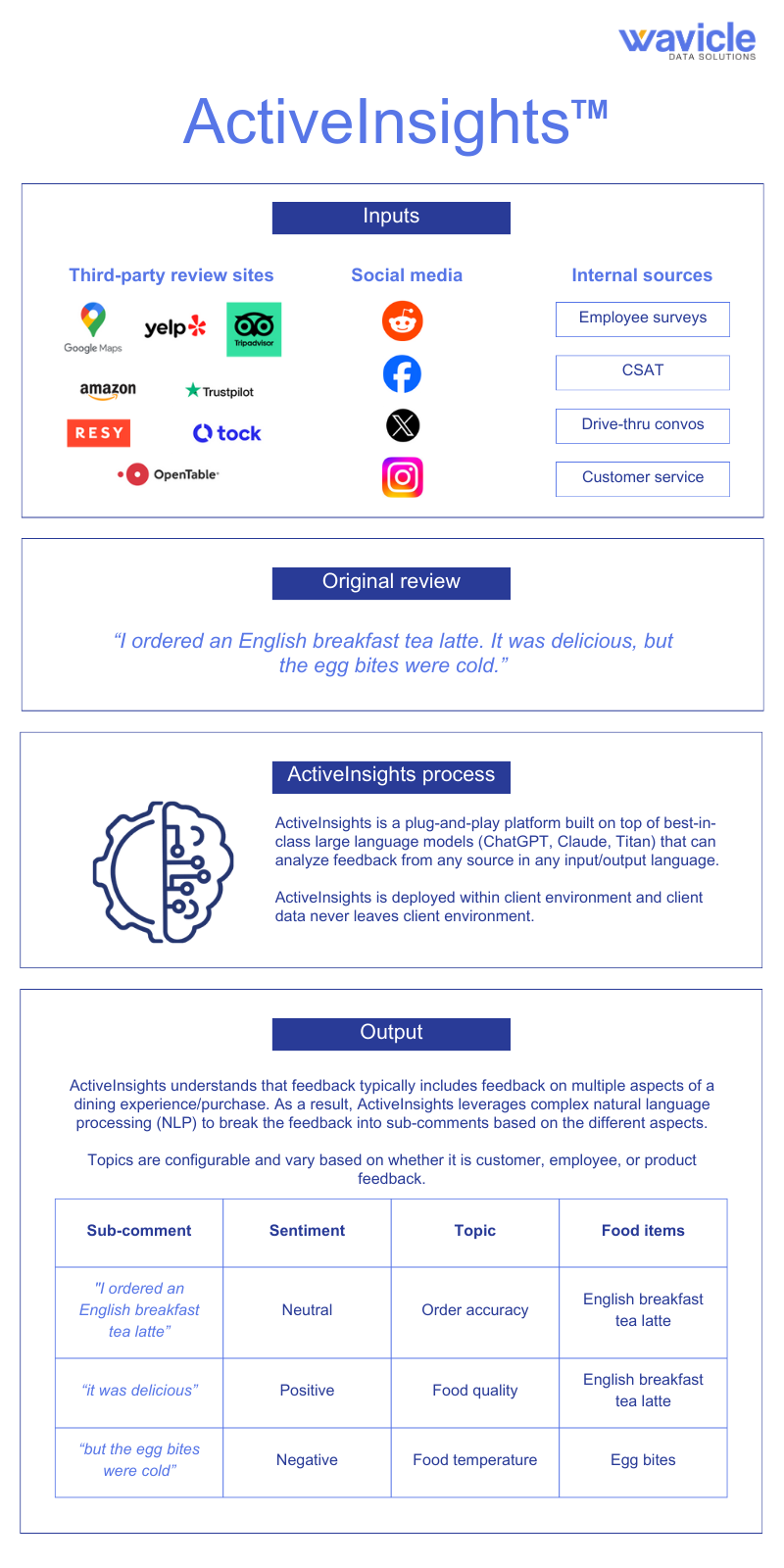
One application for this type of LLM-enabled analysis is Wavicle’s own ActiveInsights tool, a voice of customer (VoC) analytics application that is available in the AWS Marketplace and has been successfully implemented at multiple Wavicle customers. ActiveInsights is an end-to-end application that includes the ability to integrate with internal sources (like CSAT and employee feedback), third-party review sites such as Google Maps, and social media platforms to obtain location-level attributes, ratings, and reviews for each restaurant location (and competitor locations) as well as data visualizations and notifications for users. In addition, one of the platform’s core capabilities is to leverage sophisticated text analytics/natural language processing (NLP) algorithms to analyze each piece of customer feedback provided in textual format. This is a prime example of an application for LLMs where a well-engineered prompt can help organizations rapidly process and understand feedback.
As I mentioned above, a core capability of ActiveInsights is to analyze each piece of customer feedback. Each piece of feedback is systematically analyzed in the following manner:
The ActiveInsights application does all of the above and does it extremely well. While the previous version of our solution required thousands of lines of custom coding to perform the analysis, now, an LLM can be used to enable this analysis more rapidly using customized prompts.
With efficient prompt engineering, the new version of ActiveInsights has retired thousands of lines of custom code and leverages generative AI to analyze each piece of customer feedback and do the same analysis as above.
Let’s use the following review comment left on Google as an example:
“Me and my granddaughters were out for a day of shopping and we decided to stop and get something to eat. I got a Double cheese burger, fries with No salt and a Caramel iced coffee. Double cheeseburger was very dry, fries were cold and caramel iced coffee was really cold. One granddaughter had a breakfast sandwich (bacon and eggs) combo with OJ. She loved it and she ate all of it. The other got a kid’s meal and it was sic! Much better than Dunkin”
Leveraging and prompt engineering generative AI, the new version of ActiveInsights yields the following output:
Sub-comment Sentiment Topic Menu Item Me and my granddaughters were out for a day of shopping and we decided to stop and get something to eat. Neutral Customer experience None I got a Double cheeseburger, fries with No salt and a Caramel iced coffee. Neutral Order accuracy Double cheeseburger, fries, caramel iced coffee Double cheeseburger was very dry. Negative Food quality Double cheeseburger Fries were cold. Negative Food temperature Fries Caramel iced coffee was really cold. Positive Food temperature Caramel iced coffee One granddaughter had a breakfast sandwich (bacon and eggs) combo with OJ. Neutral Order accuracy Breakfast sandwich combo with OJ She loved it and she ate all of it. Positive Food quality Breakfast sandwich combo with OJ The other got a kid’s meal and it was sic! Positive Food quality Kid’s meal Much better than Dunkin. Positive Competitor mention None So how did the LLM do? To answer that, I want to focus on format and accuracy.
First, is the LLM providing the output in the correct format? The answer to that is YES, since it breaks the original comment into sub-comments, determines the sentiment, assigns each sub-comment to a topic, and identifies mentions of menu items.
Second, how accurate is the output? I have few thoughts here:
- At first glance, breaking out comments into sub-comments seems extremely accurate and perhaps better than what is part of our existing solution.
- The assignment of sentiment is better as well. Specifically, it handles a very common edge case found in feedback for restaurant visits. Customers frequently provide a comment that includes a menu item and its temperature without additional context. Using the above as an example, “fries were cold” is intuitive to us as humans. However, commercially available sentiment engines do not do this well. From the above example, you see that the LLM handled this, as well as the other sub-comment “and caramel iced coffee was really cold,” correctly.
- For the sub-comment “She loved it and she ate all of it,” it is worth noting that the LLM was able to identify that the menu item being discussed was a breakfast sandwich (although the menu item was not explicitly mentioned). In the NLP space, this is referred to as co-referencing. I’m highlighting this because the prompt engineering we constructed did NOT ask for this to be done, yet it still accomplished this!
Thinking narrowly about our solution, ActiveInsights, as well as our existing customers, the impact is meaningful in several ways. Specifically:
Thinking more broadly, how does the ability to leverage LLMs to easily perform complex analysis of customer feedback impact the enterprise software vendors in the space such as SMG, Medallia, and Qualtrics? While these platforms have a host of features, their ability to analyze customer feedback is at their core. If companies can now do this on their own with a simple, LLM-enabled application such as ActiveInsights, will they continue to spend what they spend on packaged applications for commoditized services such as the ability to execute surveys?
Are you interested in seeing if your organization can leverage the power of generative AI to measurably improve your abilities to do VoC analytics? Want to eliminate your dependency on third-party SaaS solutions that overcharge for commoditized capabilities and keep your data locked within their silos? If so, contact us to see if you qualify for a no-cost proof-of-concept that includes an analysis of your customer feedback using ActiveInsights.
Get in touch with us to learn more about how we can help you achieve this integration.

Applies AI to structured and unstructured data to uncover guest sentiment, optimize menu strategies, and enhance service delivery across locations.
View all my Posts
















 24 Apr 2026
10 min read
24 Apr 2026
10 min read
 24 Apr 2026
10 min read
24 Apr 2026
10 min read

 24 Feb 2026
5 min read
24 Feb 2026
5 min read





 07 Jul 2025
16 min read
07 Jul 2025
16 min read

 28 May 2025
3 min read
28 May 2025
3 min read


 07 May 2025
4 min read
07 May 2025
4 min read
 05 May 2025
3 min read
05 May 2025
3 min read
 02 May 2025
4 min read
02 May 2025
4 min read
 30 Apr 2025
18 min read
30 Apr 2025
18 min read
 11 Apr 2025
3 min read
11 Apr 2025
3 min read
 28 Mar 2025
2 min read
28 Mar 2025
2 min read
 28 Mar 2025
16 min read
28 Mar 2025
16 min read

 12 Mar 2025
4 min read
12 Mar 2025
4 min read
 12 Mar 2025
5 min read
12 Mar 2025
5 min read

 20 Feb 2025
23 min read
20 Feb 2025
23 min read

 09 Jan 2025
5 min read
09 Jan 2025
5 min read
 06 Jan 2025
5 min read
06 Jan 2025
5 min read
 03 Jan 2025
5 min read
03 Jan 2025
5 min read
 20 Dec 2024
21 min read
20 Dec 2024
21 min read
 19 Dec 2024
10 min read
19 Dec 2024
10 min read
 12 Dec 2024
18 min read
12 Dec 2024
18 min read
 12 Dec 2024
4 min read
12 Dec 2024
4 min read
 12 Dec 2024
6 min read
12 Dec 2024
6 min read
 11 Dec 2024
13 min read
11 Dec 2024
13 min read
 05 Dec 2024
15 min read
05 Dec 2024
15 min read
 04 Dec 2024
7 min read
04 Dec 2024
7 min read
 21 Nov 2024
5 min read
21 Nov 2024
5 min read
 12 Nov 2024
5 min read
12 Nov 2024
5 min read
 12 Nov 2024
5 min read
12 Nov 2024
5 min read
 11 Nov 2024
4 min read
11 Nov 2024
4 min read
 06 Nov 2024
12 min read
06 Nov 2024
12 min read
 05 Nov 2024
8 min read
05 Nov 2024
8 min read
 22 Oct 2024
4 min read
22 Oct 2024
4 min read
 15 Oct 2024
18 min read
15 Oct 2024
18 min read
 03 Oct 2024
5 min read
03 Oct 2024
5 min read
 25 Sep 2024
5 min read
25 Sep 2024
5 min read
 24 Sep 2024
6 min read
24 Sep 2024
6 min read
 16 Sep 2024
16 min read
16 Sep 2024
16 min read
 26 Aug 2024
14 min read
26 Aug 2024
14 min read
 21 Aug 2024
6 min read
21 Aug 2024
6 min read
 20 Aug 2024
6 min read
20 Aug 2024
6 min read
 14 Aug 2024
18 min read
14 Aug 2024
18 min read
 12 Aug 2024
6 min read
12 Aug 2024
6 min read
 01 Aug 2024
5 min read
01 Aug 2024
5 min read
 30 Jul 2024
7 min read
30 Jul 2024
7 min read
 22 Jul 2024
9 min read
22 Jul 2024
9 min read
 18 Jul 2024
5 min read
18 Jul 2024
5 min read
 11 Jul 2024
15 min read
11 Jul 2024
15 min read
 10 Jul 2024
17 min read
10 Jul 2024
17 min read
 01 Jul 2024
8 min read
01 Jul 2024
8 min read
 24 Jun 2024
5 min read
24 Jun 2024
5 min read
 11 Jun 2024
12 min read
11 Jun 2024
12 min read
 10 Jun 2024
3 min read
10 Jun 2024
3 min read
 03 Jun 2024
4 min read
03 Jun 2024
4 min read
 29 May 2024
4 min read
29 May 2024
4 min read
 22 May 2024
5 min read
22 May 2024
5 min read
 15 May 2024
4 min read
15 May 2024
4 min read
 13 May 2024
4 min read
13 May 2024
4 min read
 06 May 2024
6 min read
06 May 2024
6 min read
 30 Apr 2024
13 min read
30 Apr 2024
13 min read
 24 Apr 2024
5 min read
24 Apr 2024
5 min read

 17 Apr 2024
8 min read
17 Apr 2024
8 min read
 16 Apr 2024
14 min read
16 Apr 2024
14 min read
 10 Apr 2024
5 min read
10 Apr 2024
5 min read
 10 Apr 2024
4 min read
10 Apr 2024
4 min read
 10 Apr 2024
13 min read
10 Apr 2024
13 min read
 01 Apr 2024
4 min read
01 Apr 2024
4 min read
 28 Mar 2024
3 min read
28 Mar 2024
3 min read
 21 Mar 2024
4 min read
21 Mar 2024
4 min read
 20 Mar 2024
4 min read
20 Mar 2024
4 min read
 15 Mar 2024
13 min read
15 Mar 2024
13 min read
 13 Mar 2024
4 min read
13 Mar 2024
4 min read
 12 Mar 2024
7 min read
12 Mar 2024
7 min read
 06 Mar 2024
6 min read
06 Mar 2024
6 min read
 04 Mar 2024
5 min read
04 Mar 2024
5 min read
 15 Feb 2024
14 min read
15 Feb 2024
14 min read

 29 Jan 2024
1 min read
29 Jan 2024
1 min read
 29 Jan 2024
3 min read
29 Jan 2024
3 min read
 24 Jan 2024
8 min read
24 Jan 2024
8 min read
 18 Jan 2024
3 min read
18 Jan 2024
3 min read
 12 Dec 2023
8 min read
12 Dec 2023
8 min read
 20 Nov 2023
7 min read
20 Nov 2023
7 min read
 14 Nov 2023
6 min read
14 Nov 2023
6 min read
 24 Oct 2023
12 min read
24 Oct 2023
12 min read
 12 Oct 2023
7 min read
12 Oct 2023
7 min read

 04 Oct 2023
10 min read
04 Oct 2023
10 min read
 27 Sep 2023
4 min read
27 Sep 2023
4 min read
 25 Sep 2023
12 min read
25 Sep 2023
12 min read
 22 Sep 2023
6 min read
22 Sep 2023
6 min read
 22 Sep 2023
5 min read
22 Sep 2023
5 min read
 22 Aug 2023
6 min read
22 Aug 2023
6 min read
 01 Aug 2023
4 min read
01 Aug 2023
4 min read
 26 Jul 2023
5 min read
26 Jul 2023
5 min read
 24 Jul 2023
6 min read
24 Jul 2023
6 min read
 20 Jul 2023
7 min read
20 Jul 2023
7 min read
 18 Jul 2023
4 min read
18 Jul 2023
4 min read
 15 Jul 2023
6 min read
15 Jul 2023
6 min read
 15 Jun 2023
7 min read
15 Jun 2023
7 min read
 09 May 2023
2 min read
09 May 2023
2 min read
 07 May 2023
4 min read
07 May 2023
4 min read
 02 May 2023
7 min read
02 May 2023
7 min read
 25 Apr 2023
6 min read
25 Apr 2023
6 min read
 20 Apr 2023
2 min read
20 Apr 2023
2 min read

 04 Apr 2023
6 min read
04 Apr 2023
6 min read
 02 Mar 2023
4 min read
02 Mar 2023
4 min read

 14 Feb 2023
3 min read
14 Feb 2023
3 min read
 07 Feb 2023
4 min read
07 Feb 2023
4 min read
 02 Feb 2023
3 min read
02 Feb 2023
3 min read
 26 Jan 2023
4 min read
26 Jan 2023
4 min read
 24 Jan 2023
3 min read
24 Jan 2023
3 min read
 18 Jan 2023
8 min read
18 Jan 2023
8 min read
 12 Jan 2023
4 min read
12 Jan 2023
4 min read
 05 Jan 2023
6 min read
05 Jan 2023
6 min read
 29 Nov 2022
7 min read
29 Nov 2022
7 min read

 08 Nov 2022
7 min read
08 Nov 2022
7 min read

 25 Oct 2022
5 min read
25 Oct 2022
5 min read


 29 Sep 2022
2 min read
29 Sep 2022
2 min read

 22 Sep 2022
3 min read
22 Sep 2022
3 min read


 02 Mar 2022
4 min read
02 Mar 2022
4 min read
 24 Nov 2021
5 min read
24 Nov 2021
5 min read
 19 Oct 2021
2 min read
19 Oct 2021
2 min read
 16 Sep 2021
5 min read
16 Sep 2021
5 min read
 15 Jul 2021
8 min read
15 Jul 2021
8 min read
 21 Jun 2021
6 min read
21 Jun 2021
6 min read
 14 Jun 2021
15 min read
14 Jun 2021
15 min read
 08 Jun 2021
9 min read
08 Jun 2021
9 min read
 25 May 2021
6 min read
25 May 2021
6 min read
 25 May 2021
9 min read
25 May 2021
9 min read
 25 May 2021
7 min read
25 May 2021
7 min read
 27 Apr 2021
5 min read
27 Apr 2021
5 min read
 23 Apr 2021
6 min read
23 Apr 2021
6 min read
 07 Apr 2021
10 min read
07 Apr 2021
10 min read
 17 Feb 2021
5 min read
17 Feb 2021
5 min read
 15 Jan 2021
5 min read
15 Jan 2021
5 min read
 04 Jan 2021
4 min read
04 Jan 2021
4 min read
 04 Jan 2021
5 min read
04 Jan 2021
5 min read
 02 Dec 2020
5 min read
02 Dec 2020
5 min read
 02 Dec 2020
7 min read
02 Dec 2020
7 min read
 25 Aug 2020
9 min read
25 Aug 2020
9 min read
 10 Aug 2020
6 min read
10 Aug 2020
6 min read
 18 May 2020
6 min read
18 May 2020
6 min read
 11 May 2020
8 min read
11 May 2020
8 min read


 04 Dec 2019
7 min read
04 Dec 2019
7 min read
 04 Dec 2019
4 min read
04 Dec 2019
4 min read
 05 Nov 2019
5 min read
05 Nov 2019
5 min read


 03 Apr 2019
4 min read
03 Apr 2019
4 min read
 02 Apr 2019
7 min read
02 Apr 2019
7 min read
 16 Oct 2018
3 min read
16 Oct 2018
3 min read


