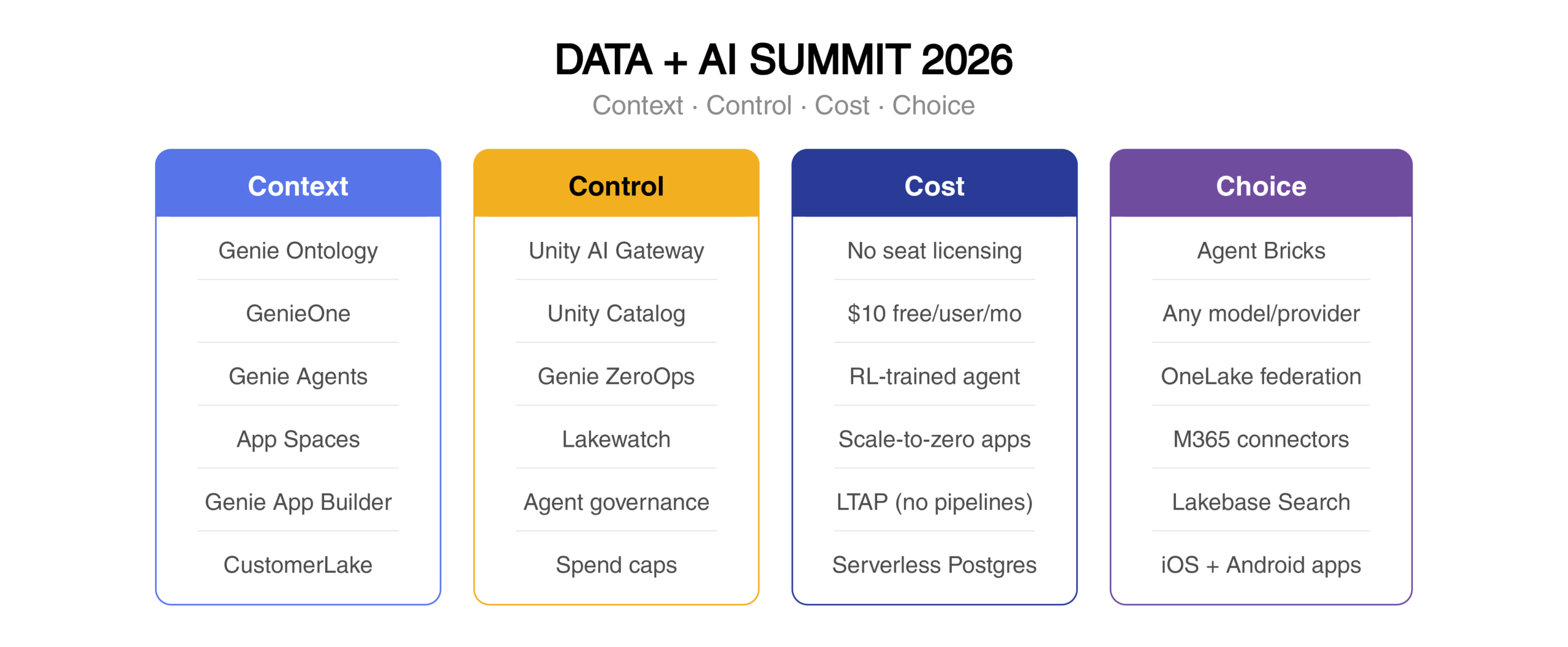
The Databricks Data + AI Summit wrapped up last week. The theme was stated plainly and early: Context, Control, Cost, and Choice. Four words that, once you hear them, make every announcement that followed feel less like a product dump and more like a deliberate argument.
If you weren’t there, or were there but spent most of it in the expo hall, here’s the actual substance (gathered from our team who was on-ground the entire week!)
TL;DR
1. The theme was Context, Control, Cost, and Choice. Every major announcement mapped back to one of those four pillars. This wasn’t a feature drop. It was an architectural statement.
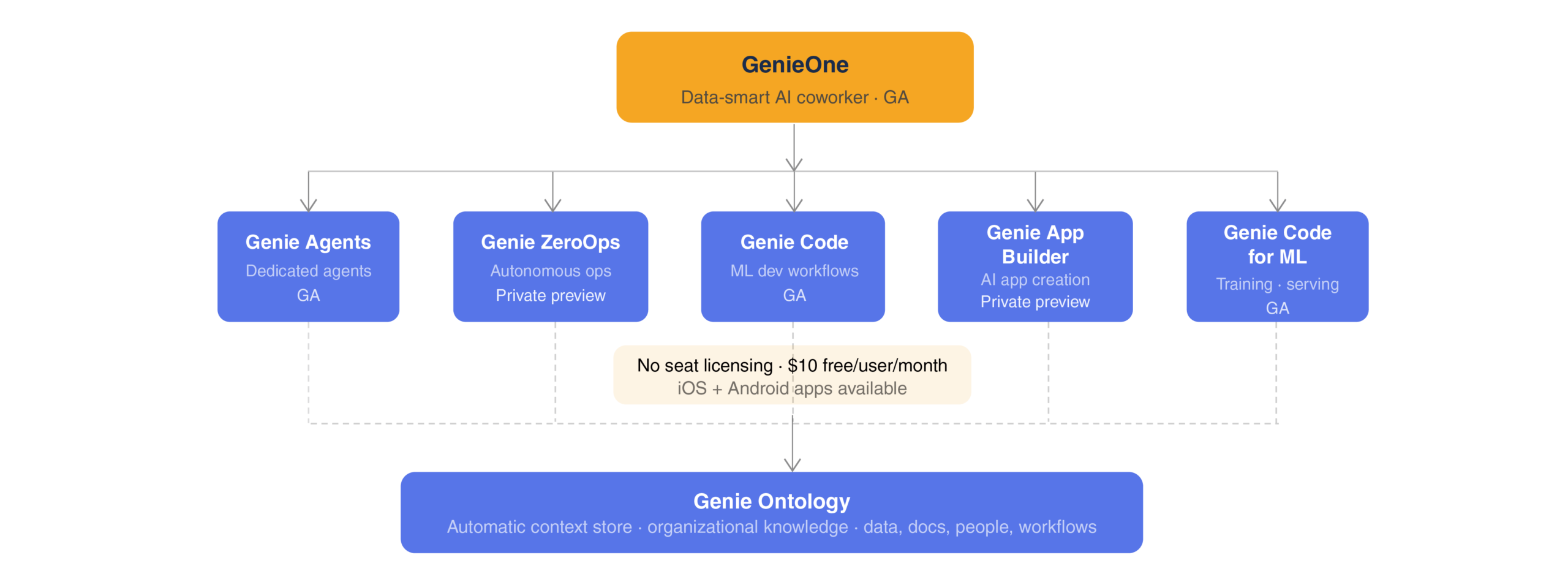
2. Genie is now a full product family. GenieOne, Genie Agents, Genie ZeroOps, Genie Code, and Genie App Builder collectively push Databricks into business-user territory, not just the data platform team.
3. LTAP and Lakebase are the infrastructure bets to watch. Unifying transactional and analytical data on one storage layer could eliminate entire categories of pipeline work over the next 12–18 months.
4. Governance is no longer optional at scale. Unity AI Gateway shipped with hard spend caps, runtime guardrails, and full Unity Catalog coverage for agents and MCP services. Set it up before you need it.
5. If you’re on legacy BI, the migration window is open. Genie is generally available, seat-free, and actively courting Tableau and Power BI users. The trust and KPI continuity problem is real, and it’s the first thing to solve.
6. Reyden and Genie Ontology were not side notes. Reyden is Databricks’ real-time performance engine for Lakehouse//RT, while Ontology is the context layer that makes Genie credible inside the enterprise. Together, they explain the real platform move: faster answers, grounded in business meaning.
The Scale, Briefly
30,000+ in-person attendees. 800+ sessions. 150 countries represented. This is no longer a niche practitioner conference. Data+AI Summit is what AWS re:Invent was a decade ago: the event where enterprise infrastructure decisions get previewed before they get made.
The guest list matched that ambition. Satya Nadella appeared in a pre-recorded fireside chat with CEO Ali Ghodsi. Mukesh Ambani from Reliance Industries in a recorded keynote shared their mission to democratize intelligence for 1.5B people. OpenAI co-founder Greg Brockman took the stage in person. PepsiCo’s Global Chief Data and AI Officer, Magesh Bagavathi, represented the enterprise buyer. The message was deliberate: the Fortune 500 is running production AI here, and here are the receipts.
The Thesis Running Through Everything
Before getting into individual announcements, it’s worth naming what Databricks was actually making clear all week.
The thesis: the lakehouse, the semantic layer, the agent runtime, and the governance layer should be one platform. Not four integrated tools. One platform. And the key theme the keynotes kept returning to wasn’t “which model is smartest?” but “which infrastructure lets enterprises run AI without failing, costing a fortune, or leaking sensitive data?”
Context, Control, Cost, Choice. Once you see those four pillars, the product announcements stop feeling random.
The Announcements, By Category
Genie: The AI Coworker Stack
Genie covered a major portion of the keynote and was clearly one of the biggest product stories from the summit. The family expanded significantly across five distinct capabilities:
- GenieOne is the headline; a data-smart AI coworker that works across all of your data, structured and unstructured, analytical and operational. The technical anchor underneath it is Genie Ontology, an automatic and secure context store that Databricks describes as a continuously improving web of organizational knowledge; spanning data, docs, tags, apps, and people. It’s designed to give agents accurate business context rather than using generic training data. In practice, this is what makes “AI that knows your business” mean something.
- Genie Agents extends this to let anyone, not just data engineers, create dedicated agents to automate specific workflows. The pitch is business-user accessible. We’ll see how the UX bears that out in practice, but the intent is clear.
- Genie ZeroOps is the one that quietly solves a problem most teams haven’t fully admitted to yet: who’s watching your production AI workloads? It’s an AI background agent that monitors production, investigates issues, and surfaces fixes. Effectively autonomous ops for the data platform.
- Genie Code handles longer-running data and ML development workflows, managing, governing, and orchestrating work across the Databricks environment. The ML extension (Genie Code for ML) specifically covers feature engineering, model training, serving, and monitoring, an end-to-end ML development loop inside the same governance surface.
- Ontology deserves to be called out as one of the bigger releases here, not just a supporting detail. Without it, Genie is another AI interface sitting on top of enterprise data. With it, Genie has a continuously updating layer of business meaning across metrics, dashboards, queries, documents, apps, and people context that helps agents answer based on how the organization actually works. That is the difference between generic conversational analytics and governed, enterprise-grade AI/BI.
On pricing: no seat licensing. Up to $10 free per user per month, pay for what you consume. That’s an aggressive entry point for enterprise pilots. Genie One, Genie Agents, and Genie Code are generally available. Genie App Builder and Genie ZeroOps entered private preview. There are now also native iOS and Android apps, a clear signal that Databricks wants Genie in the hands of business users, not just the data platform team.
Apps: Governed Deployment Infrastructure
The Apps category didn’t get the headline billing of Genie, but it matters for teams thinking about how AI gets deployed inside an organization.
- App Spaces introduces governed spaces with pre-defined resource, data access, and security policies. Rather than every team spinning up its own deployment with its own access controls, App Spaces creates a template layer for doing this consistently.
- Genie App Builder handles AI-assisted app creation with full Databricks context so the apps built here can reason over the platform’s data and governance layer, not just surface a UI on top of an API call.
- Serverless Micro Apps rounds this out with infrastructure built for scale-to-zero applications. If you’ve been avoiding Databricks-hosted apps because the always-on cost model didn’t make sense for internal tooling, this changes the math.
LTAP: The Infrastructure Bet Most People Will Underestimate
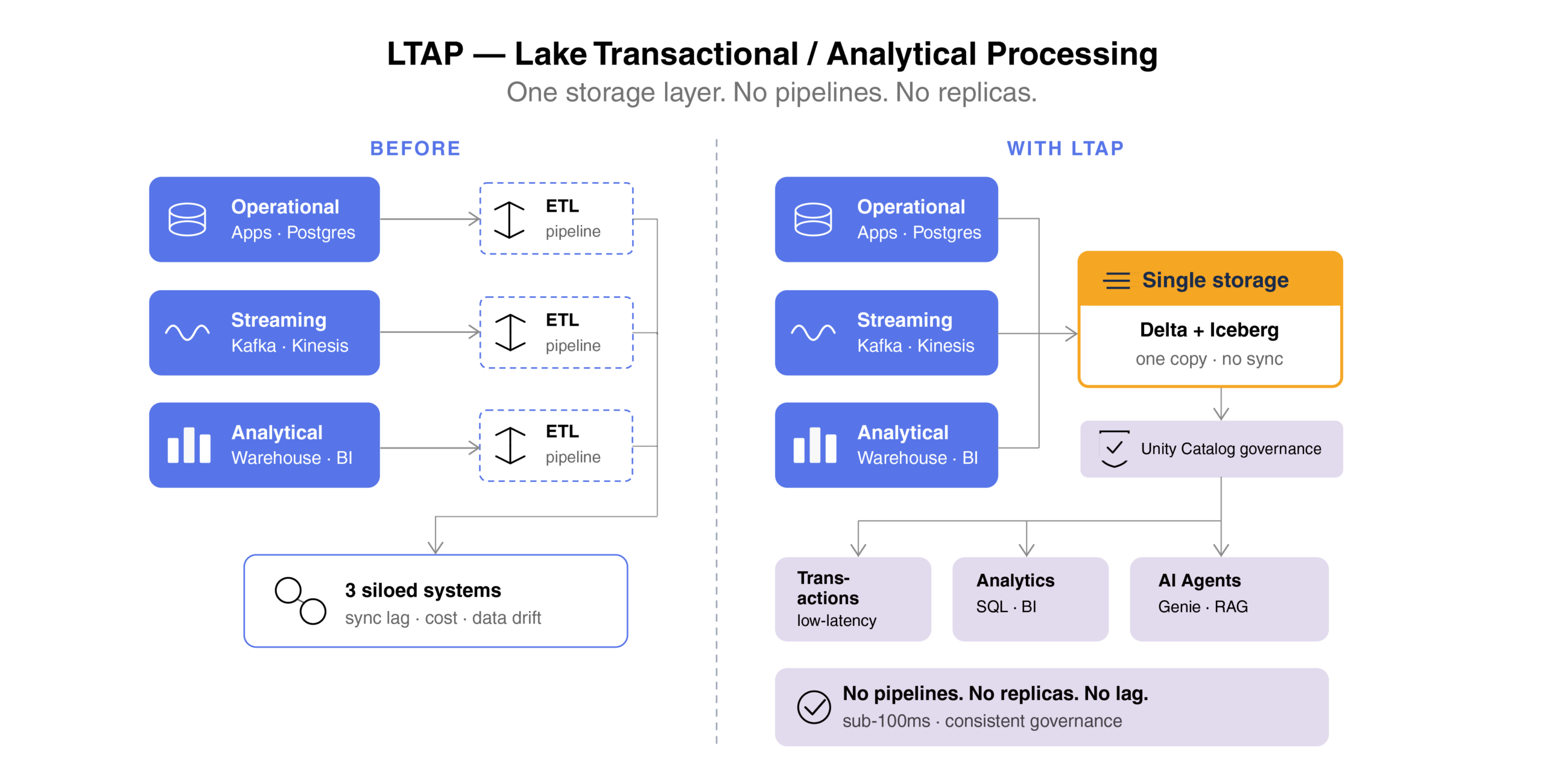
LTAP, Lake Transactional/Analytical Processing, was the most technically significant announcement, and also the one that will get the least attention in most recap posts.
The concept: unify transactions, analytics, streaming, and operational data on a single copy of storage, combining Lakebase (serverless Postgres) with the lakehouse under one governance model, no ETL pipelines, no data replicas.
If this works at scale, it removes the fundamental gap between operational systems (where data is created) and analytical systems (where data is queried). Most teams currently solve that gap with pipelines. Pipelines introduce latency, cost, and failure points. LTAP argues you don’t need the pipeline at all.
That’s a significant claim. Teams evaluating it will want to pressure-test the consistency model and cost profile before committing. But directionally, this is the architectural bet most likely to reshape how data stacks get designed over the next 12–18 months.
Reyden is the other major release that belongs in this conversation. As the engine behind Lakehouse//RT, it brings low-latency, high-concurrency analytics directly to governed lakehouse data instead of forcing teams to copy data into separate serving layers just to get real-time performance. That matters because it collapses another piece of the modern data stack: fewer replicas, fewer sync jobs, fewer governance gaps, and a clearer path to operational analytics on the same foundation used for BI and AI.
Lakebase: Now With Search Built In
Lakebase, Databricks’ serverless Postgres offering, is processing 12 million database launches per day. This week added:
- Lakebase Search: hybrid vector and full-text retrieval built natively into Lakebase
- Cross-cloud and cross-region disaster recovery
- Git-style branching and sub-second snapshots
- Autonomous operations
The hybrid search is the one to watch. If it delivers on latency and accuracy, it removes the need for a separate vector database tier in most agent architectures. One less system to maintain, one less integration to govern.
Agent Bricks: Full Developer Platform
Agent Bricks has expanded into a complete developer platform for building and deploying custom agents, with your choice of models, tools, knowledge sources, data connections, and memory, plus built-in orchestration, deployment, and governance capabilities. 100,000+ agents have already been built on the platform. It’s processing over one quadrillion agent tokens per year.
They also shipped a custom RL-trained data agent that reportedly rivals frontier models on Genie tasks at significantly lower cost per query. That cost-per-query framing isn’t incidental. Ali Ghodsi was candid on stage: “This is going to get extremely expensive. We are just scratching the surface.” Teams scaling agents without a cost governance layer are going to feel this fast.
Unity AI Gateway: Governance Before You Need It
This addressed something a lot of teams are handling poorly right now: nobody quite knows how much their AI is costing, who’s consuming what, or whether guardrails are working consistently across different models and tools.
The Unity AI Gateway now covers:
- Spend visibility across providers, with hard spend caps and intelligent routing to balance quality and cost
- Governance extended to models, agents, MCP services, and skills, all through Unity Catalog
- End-to-end traces and coding agent observability
- Incident investigation via Lakewatch
- Runtime integrations with security partners like Zscaler for AI guardrails
The consistent message from every governance session: set this up before you scale agents, not after. That sounds obvious. Most teams still don’t do it.
Microsoft: Integrations That Actually Close Gaps
The Microsoft presence went deeper than the Satya Nadella cameo. For Azure Databricks users specifically:
- OneLake Catalog Federation is now generally available. Query OneLake data directly from Azure Databricks without pipelines, duplication, or data movement. Bidirectional read between Azure Databricks and OneLake is supported.
- CustomerLake, a Customer Data Platform built inside the lakehouse rather than as a separate application, is now available. Profile Agents assemble Customer 360 profiles from fragmented sources automatically. For teams currently maintaining a separate CDP alongside their lakehouse, this is a meaningful consolidation option.
New connectors also shipped for Microsoft Teams, M365 Copilot, Excel, SharePoint, Power BI, and OneLake. These close the gap between the analytics platform and the tools where actual decisions get made.
What to Do With This?
- Evaluate Genie One for internal workflows first. No seat licensing lowers the risk of a real pilot. High-value starting points: analyst Q&A on internal data, ops reporting, data quality monitoring.
- Take LTAP seriously as an architectural direction. If you’re maintaining pipelines between operational and analytical systems, track this closely. It won’t replace your current stack overnight, but it changes the design conversation.
- Build governance before you scale. Unity AI Gateway and Unity Catalog are the foundation. Retrofitting governance onto agents already in production is a much worse path.
- Model your agentic token costs now. Ghodsi said the quiet part out loud. Do the math before the bills arrive.
- If you’re on Azure, look at the OneLake integrations and CustomerLake. Both are available now and reduce duplicate infrastructure.
- Watch Genie ZeroOps as it exits private preview. Autonomous production monitoring for data workloads is a real gap for most teams. If it works, it closes that gap without adding headcount.
The real story from this year’s Summit wasn’t one breakthrough product. It was how tightly the announcements fit together. Context, Control, Cost, Choice. Four words that, by the end of four days, had organized 800+ sessions and a dozen major announcements into something that held together. Whether the platform lives up to that architecture in practice is the question the next 12 months will answer.
What This Means If You’re a Databricks Customer Sitting on Legacy BI
Here’s where a lot of the Genie announcements get interesting in a practical sense, and where most organizations will feel the friction first.
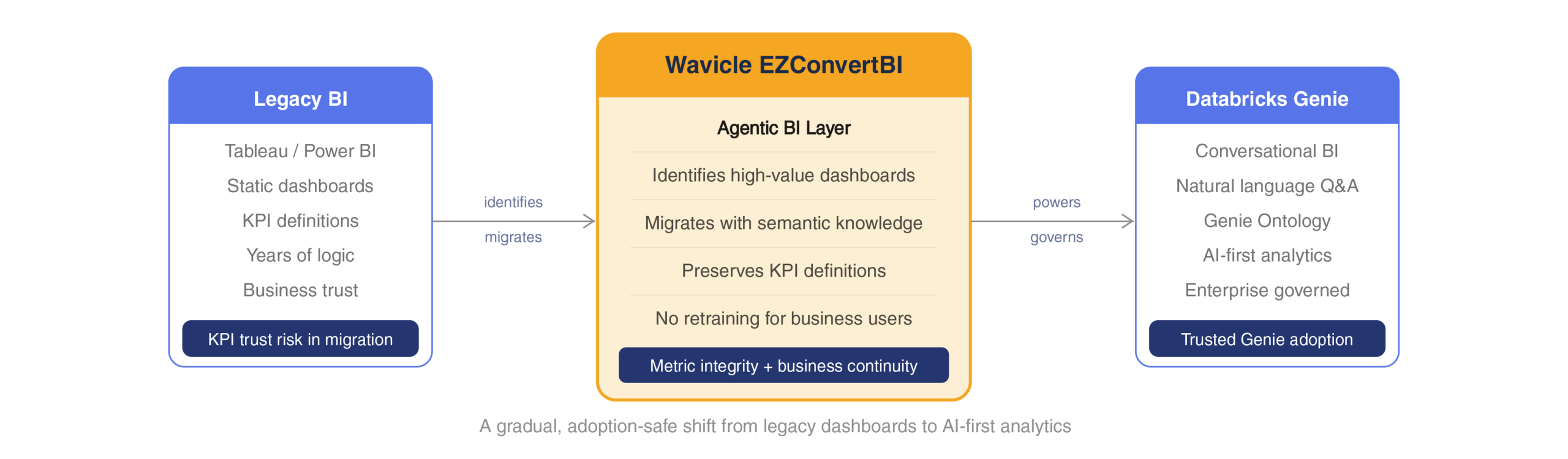
The vision Databricks laid out this week is conversational analytics: business users asking questions in plain language, getting governed answers back, no dashboard dependency. That’s a real shift. The problem is that most organizations have years of dashboards, KPIs, and reporting logic baked into Tableau, Power BI, or similar tools. Moving to Genie-first analytics isn’t just a technical migration. It’s a trust problem. Business users need to know that the numbers they’re getting from a Genie query match the numbers they’ve been making decisions on for years.
This is exactly the gap that Wavicle’s EZConvertBI was built for. It’s an Agentic BI layer that sits between your legacy BI environment and Databricks AI/BI Genie, identifying your highest-value dashboards, migrating them into Genie spaces with semantic knowledge intact, and preserving metric integrity throughout. Business users get natural-language analytics and Genie-powered insights without retraining or a disruptive cutover. The shift from dashboard-driven to conversational BI happens gradually, which is how enterprise adoption works in practice.
The Summit announcements, particularly Genie One’s general availability, the no-seat-licensing model, and the push toward business-user accessibility, make the migration window more urgent. The platform is ready. The question for most organizations is whether their path to adoption is. A lot of teams are going to try to move fast and discover the KPI trust problem the hard way.
Watch the EZConvertBI demo to see how the migration layer works in practice, or read how Wavicle approaches trusted Genie adoption without breaking the metrics your business already relies on.
Ready to Figure Out Where You Stand?
The Summit made one thing clear: Databricks’ AI/BI roadmap is moving fast. Whether you’re still evaluating Genie, mid-migration from a legacy BI tool, or trying to understand how the new product surface fits into what you’ve already built, the strategy decisions you make in the next few months will matter.
Wavicle offers a Databricks AI/BI Strategy Session, a focused working session to help you map your current analytics environment against what’s now possible, identify where Genie adoption makes the most immediate sense, and build a realistic path forward that doesn’t require throwing out what’s already working.
No generic slide decks. Just a practical conversation about your stack, your KPIs, and where to start.


 23 Jun 2026
 13 min read