


How Data Mesh is Shaping the Future of Data Management
- Architecture & Engineering
- Cloud Infrastructure Modernization
- Data Management
- Strategy & Assessments
 05 Nov 2024
- 8 min read
 05 Nov 2024
 8 min read


Data mesh has been gaining traction among organizations as they seek more scalable, decentralized data architectures. At its core, data mesh breaks away from traditional, centralized data architectures by focusing on domain-driven ownership.
However, the approach isn’t a one-size-fits-all solution, and it’s crucial to identify the scenarios where a data mesh architecture makes sense. Let’s explore the basics of data mesh, when it’s the right fit for your organization, how data products and data mesh fit together, and what real-world implementations look like in action.
Understanding the data mesh approach to data management
To begin, understanding the inspiration behind the data mesh architecture is essential. Over the past two decades, some of the world’s most successful companies – businesses like Airbnb and Uber – have built their businesses by connecting producers with consumers through data-driven platforms. Their success is rooted in network orchestration, characterized by a focus on user experience, enabling tools for transactions, and leveraging data to aggregate supply and demand. However, a critical but lesser-known aspect of their success is their use of domain-driven design, which rejects monolithic architectures in favor of focusing on distinct business domains.
This principle of domain-driven design influenced the creation of the data mesh architecture in 2019, spearheaded by Zhamak Dehghani. Data mesh embraces decentralized data ownership, treating data as a product and establishing autonomous domains responsible for their own data. It’s important to note that data mesh is not a product or a piece of technology. Instead, it comprises four key principles, each essential to understanding how the architecture functions.
- Domain ownership: The first principle is domain-oriented data ownership, which is often the most disruptive. In a data mesh, ownership of the data resides with the domain that creates and consumes it. For example, the finance department would manage its own financial data because it understands the data’s nuances and use cases better than a centralized IT team. This decentralization goes beyond analytics, extending to operational and transactional systems as well. Each domain becomes responsible for managing its own data products, including ensuring quality and relevance for the teams that need them.
- Data as a product: The second principle is that data products are treated as continuously evolving assets, unlike traditional projects with fixed start and end dates. The goal is to maintain high-quality data that can be leveraged by other domains, ensuring usability across the organization. This shifts the focus away from one-off projects and toward the ongoing management of data products.
- Self-service data platforms: The third principle emphasizes the importance of frictionless data sharing between producers and consumers. Various tools—such as data catalogs, data lineage systems, and data marketplaces—are used to enable this. While many vendors claim to offer “data mesh” products, what they’re really providing is one part of this larger infrastructure, which enables a smooth exchange of data within the organization.
- Federated governance: The final principle is federated data governance. Unlike centralized governance models, federated governance allows for decentralized control while still maintaining necessary oversight for data security, compliance, and regulation. While each domain governs its own data, it must still adhere to overarching governance rules to ensure consistency and compliance across the organization.
Key considerations for adopting data mesh
The data mesh methodology is particularly beneficial for companies with dedicated domain data and analytics teams, allowing them to foster ownership and prioritize end users in their data-driven initiatives. For successful implementation, strong executive support and a long-term commitment to strategic transformation are essential, especially for those that have historically struggled to scale centralized data models in response to increasing data volumes and diversity.
Organizations with advanced technological infrastructures and engineering practices can utilize data mesh to enhance scalability and improve data quality, all while implementing granular security controls at the data product level. Additionally, a decentralized governance framework empowers domain teams to operate more independently, facilitating agility alongside centralized policy enforcement. Ultimately, organizations that can dedicate the necessary resources and maintain a long-term vision find that adopting data mesh principles can significantly enhance their data management capabilities.
While the data mesh approach offers significant benefits for many organizations, it may not be suitable for all. Small organizations with limited data and analytics resources might find that a centralized data team serves their needs more efficiently, while extremely large and complex organizations could struggle with the added overhead and coordination challenges that data mesh introduces. Additionally, a lack of a clear data strategy or low data maturity can hinder successful implementation; organizations must possess a defined vision, measurable goals, and advanced data engineering practices to navigate the complexities of data mesh effectively.
Cultural factors also play a crucial role. Organizations that rely on top-down decision-making or lack cross-functional, domain-oriented teams may find it difficult to adopt this decentralized model. Furthermore, sufficient talent and resources are essential, as data mesh requires a commitment to long-term development rather than short-term fixes. Ultimately, organizations that do not prioritize analytical focus or data product development processes may discover that data mesh is misaligned with their business needs, making it a less effective choice for their data management strategy.
Core components of a data mesh architecture
Let’s take a look at a simplified example of a data mesh architecture that highlights essential components working together. It demonstrates how different teams can independently manage their data while ensuring it’s discoverable and reusable across the organization, fostering seamless collaboration and innovation.

(In this image, you will see a simplified sample layout of data mesh framework with key elements)
In this example, you will notice:
- Multiple domains work together to build use cases under federated data governance. While different domains manage their own data, they adhere to common standards and policies for data integration, access, and security.
- Raw data is stored locally and owned by domains. Raw data is managed and stored by the domains that generate it, ensuring that the domains have full ownership and control over their data.
- Domain teams turn raw data into data products. Each domain team is responsible for processing and refining raw data into data products that can be reused for multiple use cases.
- Domain-agnostic self-serve tooling and infrastructure dominate. Tools and infrastructure are not tied to any specific domain but enable any team within the organization to locate, understand, access, process, and use data as needed.
Data mesh in action: Practical implementations across departments
Let’s take a look at the structured breakdown of a real-world scenario, highlighting how a data mesh architecture contributes to cross-domain use cases and empowers teams to leverage each other’s data products within the organization.
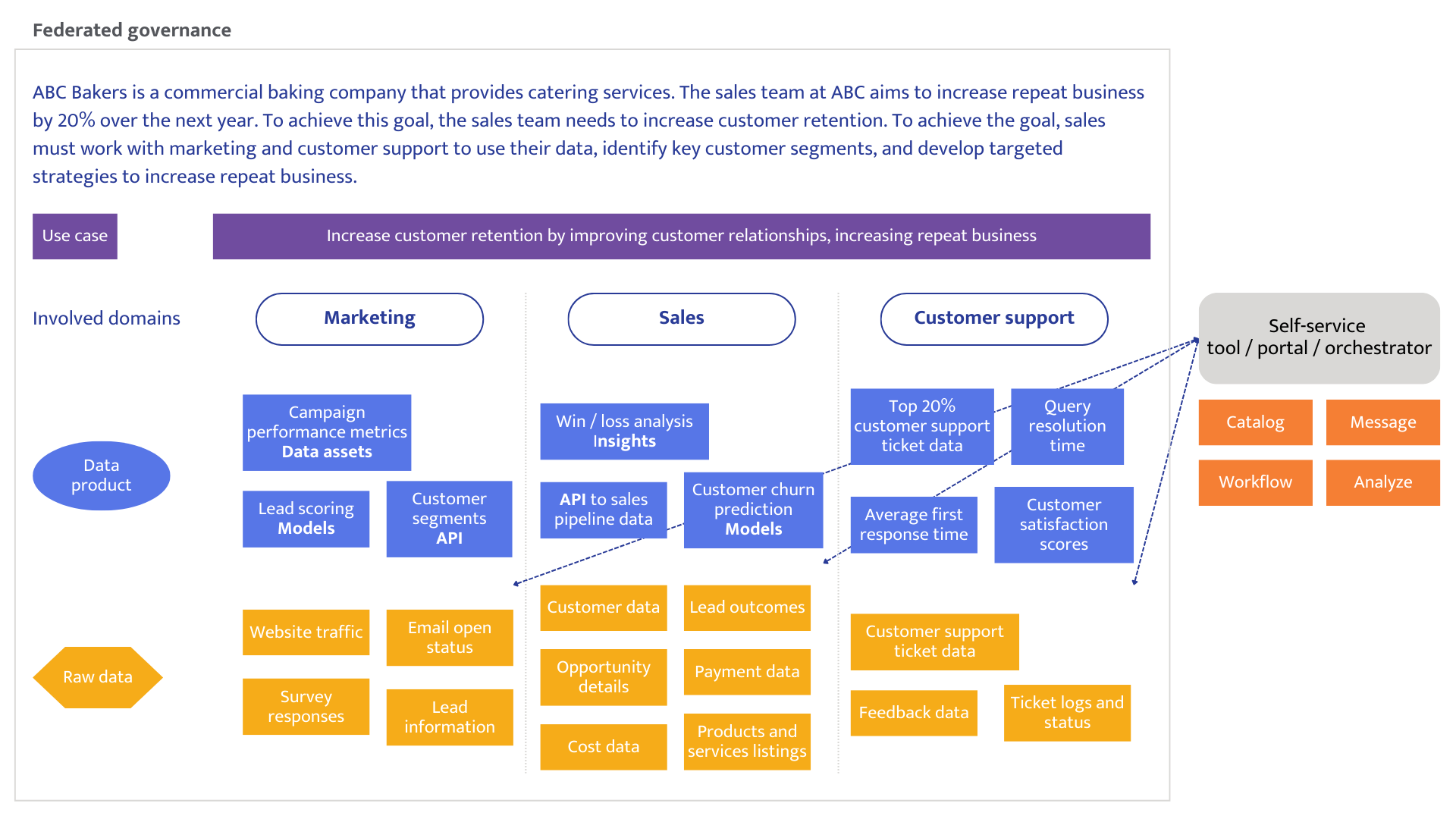
(In the image, you will see how data products from each domain are made available for use across the organization, demonstrating the power of data mesh)
In the scenario described, you can see how a data mesh framework facilitates seamless collaboration across domains—in this example, sales, marketing, and customer support—within an organization. Each team operates with decentralized ownership of its own data products, which are made accessible through a self-service orchestrator. For example:
- The sales team aims to increase customer retention by leveraging data from both marketing and customer support.
- The marketing team provides insights through a lead sourcing model and campaign performance metrics available on the orchestrator.
- The customer support team offers data products such as ticket status and customer satisfaction metrics that can be easily accessed and analyzed by other teams.
This setup eliminates the need for lengthy processes, such as going through centralized IT, and allows teams to directly access the data they need, speeding up the execution of business initiatives.
By using a self-service platform or orchestrator, each team can easily discover, request, and integrate data products from other domains, enabling cross-domain use cases. Teams can collaborate, share insights, and use data more efficiently to achieve their common goal—in this case, increasing repeat business.
Embracing data mesh for scalable success
By decentralizing data management and empowering individual domains, data mesh helps businesses overcome the inefficiencies of traditional data frameworks. Organizations can achieve greater agility, as teams are no longer waiting for central data teams to fulfill requests. They can also scale faster, as each domain can evolve its own data products without affecting others.
Moreover, by treating data as a product and ensuring strong governance through a federated model, businesses can achieve higher data quality, better decision-making, and improved compliance. As data becomes more accessible and reliable, organizations can leverage insights to drive innovation, optimize operations, and maintain a competitive edge.
Overall, data mesh offers a powerful framework for modernizing data management, aligning business and IT goals, and unlocking the full value of enterprise data. If you’d like to tap into the full potential of your data with a decentralized, scalable approach, get in touch with Wavicle. Our expertise in data mesh can help you modernize your data management and build a data ecosystem that works for you.
WIT Leader

Data Team
Builds secure, governed data platforms that power analytics and feed AI models with clean, real-time, and high-quality data.
View all my PostsRelated Posts






















- Blog
- Automated BI Migration
- Conversational Analytics
Automated BI Migration: Moving Tableau and Powe...
-
24 Apr 2026
-
10 min read

- Blog
- Automated ETL Migration
- AWS Glue
ETL Migration Cost Optimization: Legacy ETL to ...
-
24 Apr 2026
-
10 min read


- Blog
- Azure
- Databricks
Enabling Near Real-Time Operational Decision-Ma...
-
24 Feb 2026
-
5 min read





- Blog
- Advanced Analytics
- Healthcare
Computer Vision for Health: Living Longer
-
07 Jul 2025
-
16 min read


- Blog
- Amazon Quicksight
- BI Reporting & Visualizations
5 Major Benefits of Amazon Quick Suite That you...
-
28 May 2025
-
3 min read


- Blog
- Amazon Quicksight
- BI Reporting & Visualizations
Tips and Tricks to Get the Most Out of Amazon Q...
-
07 May 2025
-
4 min read

- Blog
- Data Governance
- Healthcare
Rethinking Healthcare Data Governance: From Sil...
-
05 May 2025
-
3 min read


- Blog
- Data Management
- Healthcare
Building the Future of Healthcare Through Flawl...
-
02 May 2025
-
4 min read

- Blog
- Environmental Social & Governance (ESG)
Leveraging AI to Optimize Energy Consumption of...
-
30 Apr 2025
-
18 min read

- Blog
- Advanced Analytics
- Predictive Modeling
Predicting the Unpredictable: Leveraging AI to ...
-
11 Apr 2025
-
3 min read


- Blog
- Demand Forecasting
- Retail
The AI Storefront: How Retail and CPG Leaders C...
-
28 Mar 2025
-
2 min read


- Blog
- Advanced Analytics
When and Where GenAI Actually Makes Sense in Kn...
-
28 Mar 2025
-
16 min read


- Blog
- Advanced Analytics
- Retail
Navigating Ethical Issues of AI in Retail
-
12 Mar 2025
-
4 min read

- Blog
- Advanced Analytics
- Generative AI & LLM
How Generative AI is Transforming Retail Custom...
-
12 Mar 2025
-
5 min read


- Blog
- Data Governance
Back to Basics: Essentials for Product Developm...
-
20 Feb 2025
-
23 min read


- Blog
- Advanced Analytics
- Generative AI & LLM
How Text Analytics and Generative AI Are Unlock...
-
09 Jan 2025
-
5 min read

- Blog
- BI Reporting & Visualizations
- Business Intelligence & Insights
Transforming BI Reporting and Visualization Wit...
-
06 Jan 2025
-
5 min read

- Blog
- Cloud Infrastructure Modernization
- Platform Management
Mastering Cloud Cost Optimization for a More Ef...
-
03 Jan 2025
-
5 min read

- Blog
- Advanced Analytics
- Generative AI & LLM
How Generative AI is Transforming the Retail Ex...
-
20 Dec 2024
-
21 min read

- Blog
- Advanced Analytics
Preparing your Business for an AI-Driven Future
-
19 Dec 2024
-
10 min read

- Blog
- Advanced Analytics
What it Means to be Human in the Age of AI
-
12 Dec 2024
-
18 min read

- Blog
- Business Intelligence & Insights
- Reporting Modernization
How EZConvertBI Simplifies Your Looker Migration
-
12 Dec 2024
-
4 min read

- Blog
- Advanced Analytics
- Business Intelligence & Insights
Transforming Business Intelligence with Looker
-
12 Dec 2024
-
6 min read

- Blog
- Advanced Analytics
- Data Governance
Key Challenges in AI Adoption for Businesses
-
11 Dec 2024
-
13 min read

- Blog
- Advanced Analytics
- Generative AI & LLM
What AI Disruption Means for Businesses
-
05 Dec 2024
-
15 min read

- Blog
- Advanced Analytics
- Business Intelligence & Insights
Optimizing Your Cloud Data Platform with Google...
-
04 Dec 2024
-
7 min read

- Blog
- Advanced Analytics
- Amazon Quicksight
From Shopfloor to Boardroom: Get Your Data to T...
-
21 Nov 2024
-
5 min read


- Blog
- BI Reporting & Visualizations
- Build & Migrations
Let Your Data Speak to You – Unlocking Organiza...
-
12 Nov 2024
-
5 min read

- Blog
- Advanced Analytics
- Business Analytics
The Joy of Decision-Making and Why It Matters
-
12 Nov 2024
-
5 min read

- Blog
- Data Management
- Strategy & Assessments
Understanding Data Products
-
11 Nov 2024
-
4 min read

- Blog
- Advanced Analytics
- Generative AI & LLM
Crafting User-Focused Solutions and Building an...
-
06 Nov 2024
-
12 min read

- Blog
- Business Intelligence & Insights
- Reporting Modernization
Streamline your Power BI Migration with EZConve...
-
22 Oct 2024
-
4 min read

- Blog
- Advanced Analytics
Maximizing Business Transformation Through AI a...
-
15 Oct 2024
-
18 min read

- Blog
- Advanced Analytics
- BI Reporting & Visualizations
How Gen AI and Microsoft Copilot are Reshaping ...
-
03 Oct 2024
-
5 min read

- Blog
- Advanced Analytics
- Build & Migrations
Transforming Data Capabilities by Moving Beyond...
-
25 Sep 2024
-
5 min read

- Blog
- Business Analytics
- Business Intelligence & Insights
How to Build a Restaurant Performance Measureme...
-
24 Sep 2024
-
6 min read

- Blog
- Advanced Analytics
- Business Analytics
Leveraging Data Science and AI to Drive Innovat...
-
16 Sep 2024
-
16 min read

- Blog
- Advanced Analytics
- Generative AI & LLM
The Role of Mature Data and AI in Accurate Gene...
-
26 Aug 2024
-
14 min read

- Blog
- Advanced Analytics
- Business Analytics
Listening to the Voice of the Customer: A Key t...
-
21 Aug 2024
-
6 min read

- Blog
- Azure
- BI Reporting & Visualizations
Moving from Tableau to Power BI: Why Companies ...
-
20 Aug 2024
-
6 min read

- Blog
- Advanced Analytics
How AI Impacts the Ways We Develop and Grow Dat...
-
14 Aug 2024
-
18 min read

- Blog
- Advanced Analytics
- Demand Forecasting
How to Use Demand Forecasting to Improve Busine...
-
12 Aug 2024
-
6 min read


- Blog
- Business Intelligence & Insights
- Cloud Infrastructure Modernization
Building a Data Platform on Snowflake
-
01 Aug 2024
-
5 min read

- Blog
- Advanced Analytics
- Demand Forecasting
Why Your Demand Forecasting Model Doesn’t Work ...
-
30 Jul 2024
-
7 min read

- Blog
- Advanced Analytics
- Data Governance
Expert Insights on Demonstrating the Value of D...
-
22 Jul 2024
-
9 min read

- Blog
- Advanced Analytics
- Generative AI & LLM
How to Effectively Harness Gen AI for Your Busi...
-
18 Jul 2024
-
5 min read

- Blog
- Advanced Analytics
- Generative AI & LLM
Navigating the AI Hype Cycle by Setting Realist...
-
11 Jul 2024
-
15 min read

- Blog
- Advanced Analytics
- Data Management
Leveraging AI Technology in Healthcare
-
10 Jul 2024
-
17 min read

- Blog
- Advanced Analytics
- Data Governance
Expert Insights on Leveraging Data Quality and ...
-
01 Jul 2024
-
8 min read

- Blog
- Data Governance
- Privacy Governance & Compliance
Choosing the Right Data Governance Approach for...
-
24 Jun 2024
-
5 min read

- Blog
- Data Governance
- Privacy Governance & Compliance
Expert Insights on Leveraging Data Governance f...
-
11 Jun 2024
-
12 min read

- Blog
- Data Governance
- Data Management
The Role of Existing Data Stewards in Driving G...
-
10 Jun 2024
-
3 min read

- Blog
- Data Governance
- Data Management
Optimizing Data Governance Programs Beyond Chec...
-
03 Jun 2024
-
4 min read

- Blog
- Data Governance
- Privacy Governance & Compliance
Measuring Data Governance Progress With Metrics...
-
29 May 2024
-
4 min read

- Blog
- Data Governance
- Data Management
Decoding Data Governance: Going Beyond its Name
-
22 May 2024
-
5 min read

- Blog
- Business Analytics
- Business Intelligence & Insights
How Your Data Governance Strategy Supports Data...
-
15 May 2024
-
4 min read

- Blog
- Data Governance
- Privacy Governance & Compliance
The Need for Data Governance in a Changing World
-
13 May 2024
-
4 min read

- Blog
- Manufacturing
How Smart Manufacturing and Digital Twins Are H...
-
06 May 2024
-
6 min read

- Blog
- Advanced Analytics
- Data Management
Crafting a Data Strategy to Support AI in Healt...
-
30 Apr 2024
-
13 min read


- Blog
- Data Management
- Data Privacy & Regulatory Compliance
How to Achieve Compliance Excellence in Healthc...
-
24 Apr 2024
-
5 min read


- Blog
- Environmental Social & Governance (ESG)
- Manufacturing
Modernizing Supply Chains for Resilience and Su...
-
17 Apr 2024
-
8 min read

- Blog
- Advanced Analytics
- Business Analytics
Getting the Absolute Best Data Science Talent t...
-
16 Apr 2024
-
14 min read

- Blog
- Architecture & Engineering
- Data Management
How to Design a Modern Data Architecture
-
10 Apr 2024
-
5 min read

- Blog
- Advanced Analytics
- Predictive Modeling
How to Re-imagine Customer Experience With Pred...
-
10 Apr 2024
-
4 min read

- Blog
- Advanced Analytics
- Generative AI & LLM
Expert Insights on Transformative AI Strategies...
-
10 Apr 2024
-
13 min read

- Blog
- Data Management
- Strategy & Assessments
Why Your Organization Needs a Data Strategy
-
01 Apr 2024
-
4 min read

- Blog
- Data Management
- Strategy & Assessments
Getting Started With Data Strategy: The AI-Led ...
-
28 Mar 2024
-
3 min read

- Blog
- Cloud Infrastructure Modernization
- Cloud Security & Monitoring
The Role of AI and ML in Cloud Security Monitoring
-
21 Mar 2024
-
4 min read

- Blog
- Data Management
- Strategy & Assessments
Getting Started With Data Strategy: The Acceler...
-
20 Mar 2024
-
4 min read

- Blog
- Advanced Analytics
The Role of the Chief AI Officer (CAIO)
-
15 Mar 2024
-
13 min read

- Blog
- Data Management
- Strategy & Assessments
Getting Started With Data Strategy: The Traditi...
-
13 Mar 2024
-
4 min read

- Blog
- Healthcare
- Strategy & Assessments
How Building a Strong Data Strategy Boosts Heal...
-
12 Mar 2024
-
7 min read

- Blog
- Data Management
- Strategy & Assessments
The Do’s and Don’ts of Data Strategy
-
06 Mar 2024
-
6 min read

- Blog
- Advanced Analytics
- Manufacturing
The Role of Advanced Analytics and AI in Reduci...
-
04 Mar 2024
-
5 min read

- Blog
- Advanced Analytics
- Data Management
Reducing Barriers to Complex Data Science Entry...
-
15 Feb 2024
-
14 min read


- Blog
- Amazon Quicksight
- AWS
Mastering the Art of Visual Storytelling: Wavic...
-
29 Jan 2024
-
1 min read

- Blog
- Amazon Quicksight
- AWS
Getting to Know the Tableau-to-Amazon Quick Sui...
-
29 Jan 2024
-
3 min read


- Blog
- Manufacturing
Manufacturing Metrics That Elevate Performance ...
-
24 Jan 2024
-
8 min read

- Blog
- Restaurant
Mastering the Increasingly Complex QSR Landscape
-
18 Jan 2024
-
3 min read

- Blog
- Advanced Analytics
- Manufacturing
Manufacturing in 2024: Key Data and Analytics T...
-
12 Dec 2023
-
8 min read

- Blog
- Advanced Analytics
- Business Analytics
Data-Driven Dining: Three Essential Data, Analy...
-
20 Nov 2023
-
7 min read

- Blog
- Healthcare
2024 Healthcare Trends: Reimagining the Industr...
-
14 Nov 2023
-
6 min read

- Blog
- Advanced Analytics
- Business Analytics
Demystifying Data and Analytics
-
24 Oct 2023
-
12 min read

- Blog
- Healthcare
Exploring Data and Analytics in Healthcare: A Q...
-
12 Oct 2023
-
7 min read


- Blog
- Advanced Analytics
- Predictive Modeling
Revolutionizing Your Customer Experience Measur...
-
04 Oct 2023
-
10 min read

- Blog
- Business Analytics
- Business Intelligence & Insights
How Integrating Reservation and POS Data Can Pr...
-
27 Sep 2023
-
4 min read

- Blog
- Advanced Analytics
- Business Intelligence & Insights
Next-Generation CDOs: A Conversation About the ...
-
25 Sep 2023
-
12 min read

- Blog
- Data Management
How Effective Data Management Helps to Realize ...
-
22 Sep 2023
-
6 min read

- Blog
- Business Intelligence & Insights
Why Data Analytics Projects Fail and How to Ove...
-
22 Sep 2023
-
5 min read


- Blog
- Advanced Analytics
- Machine Learning & MLOps
How to Build Resilient Business Strategies Usin...
-
22 Aug 2023
-
6 min read

- Blog
- Business Analytics
- Manufacturing
3 Ways Data Analytics Can Transform Your Supply...
-
01 Aug 2023
-
4 min read

- Blog
- Business Analytics
- Manufacturing
How is Data Analytics Transforming Production?
-
26 Jul 2023
-
5 min read

- Blog
- Advanced Analytics
- Predictive Modeling
5 Blockers to Effective Artificial Intelligence...
-
24 Jul 2023
-
6 min read

- Blog
- Data Governance
- Data Management
Instilling Data Quality Into Your Data Manageme...
-
20 Jul 2023
-
7 min read


- Blog
- Advanced Analytics
- Business Analytics
3 Ways Engineers Can Drive Business Value with ...
-
18 Jul 2023
-
4 min read

- Blog
- Advanced Analytics
- Predictive Modeling
Calculating ROI for Advanced Analytics Initiatives
-
15 Jul 2023
-
6 min read

- Blog
- Data Management
- Strategy & Assessments
How Business Leaders Leverage Data as a Critica...
-
15 Jun 2023
-
7 min read

- Blog
- Amazon Quicksight
- BI Reporting & Visualizations
Clear and Actionable: Wavicle’s Winning Dashboard
-
09 May 2023
-
2 min read

- Blog
- Cloud Infrastructure Modernization
- Platform Management
The Importance of Effective Cloud Platform Mana...
-
07 May 2023
-
4 min read

- Blog
- Data Management
How Businesses Benefit from Modern Data Managem...
-
02 May 2023
-
7 min read

- Blog
- Architecture & Engineering
- Data Management
Data Architecture 101: Trends and Terms to Know
-
25 Apr 2023
-
6 min read

- Blog
- Restaurant
Building a Contact-Free Smart System
-
20 Apr 2023
-
2 min read


- Blog
- Build & Migrations
- Data Management
Which Data Storage Solution is Right for Your O...
-
04 Apr 2023
-
6 min read

- Blog
- Manufacturing
What’s Next in Manufacturing? A Q&A With T...
-
02 Mar 2023
-
4 min read


- Blog
- Data Governance
Governing Your Data: How to Start Designing a G...
-
14 Feb 2023
-
3 min read

- Blog
- Data Governance
Data Governance Roles: Who Should Govern Your D...
-
07 Feb 2023
-
4 min read

- Blog
- Financial Services
Financial Services Executive Outlook: The Benef...
-
02 Feb 2023
-
3 min read


- Blog
- Financial Services
Financial Services Executive Outlook: The Path ...
-
26 Jan 2023
-
4 min read

- Blog
- Data Governance
The Path to Data Governance: What Data Will Be ...
-
24 Jan 2023
-
3 min read

- Blog
- ActiveInsights
- Advanced Analytics
The Future of Voice of Customer: 5 Trends to Watch
-
18 Jan 2023
-
8 min read

- Blog
- Financial Services
Financial Services Executive Outlook: Capitaliz...
-
12 Jan 2023
-
4 min read

- Blog
- Data Governance
What is a Customer? How Simple Questions Get Co...
-
05 Jan 2023
-
6 min read

-
29 Nov 2022
-
7 min read


- Blog
- Data Governance
- Data Privacy & Regulatory Compliance
Why a Good Governance, Privacy, and Compliance ...
-
08 Nov 2022
-
7 min read


- Blog
- Data Governance
Data Governance for Business Leaders: 3 Concept...
-
25 Oct 2022
-
5 min read


- Blog
- Financial Services
Financial Services Executive Outlook: The Impac...
-
29 Sep 2022
-
2 min read


- Blog
- Financial Services
Financial Services Executive Outlook: The Reali...
-
22 Sep 2022
-
3 min read


- Blog
- Augment
- AWS
ETL Modernization: Reduce Migration Timelines a...
-
02 Mar 2022
-
4 min read

- Blog
- Advanced Analytics
- Machine Learning & MLOps
Five Steps To Operationalizing Advanced Analyti...
-
24 Nov 2021
-
5 min read

- Blog
- Augment
- Data Privacy & Regulatory Compliance
A New Way to Quickly and Easily Discover PII Da...
-
19 Oct 2021
-
2 min read

- Blog
- Architecture & Engineering
- Augment
6 Reasons You Need an Augmented Data Quality So...
-
16 Sep 2021
-
5 min read

- Blog
- ActiveInsights
- Business Analytics
Ditch the Survey and Really Get to Know Your Cu...
-
15 Jul 2021
-
8 min read

- Blog
- Architecture & Engineering
- Business Analytics
Five Reasons Why Boutique Consulting Firms Are ...
-
21 Jun 2021
-
6 min read

- Blog
- Advanced Analytics
- Machine Learning & MLOps
Deep Multi-Input Models Transfer Learning For I...
-
14 Jun 2021
-
15 min read

- Blog
- Advanced Analytics
- Machine Learning & MLOps
Deep Learning For Natural Language Processing o...
-
08 Jun 2021
-
9 min read

- Blog
- ActiveInsights
- Customer 360
5 Ways to Successfully Win Travelers’ Loy...
-
25 May 2021
-
6 min read

- Blog
- Business Analytics
- Business Intelligence & Insights
Want to Meet Consumer Expectations? Demand Fore...
-
25 May 2021
-
9 min read

- Blog
- Advanced Analytics
- Customer 360
These 3 Top Retail Analytics Trends are Revolut...
-
25 May 2021
-
7 min read

- Blog
- Demand Forecasting
Demand Forecasting Is Always Wrong: Three Ways ...
-
27 Apr 2021
-
5 min read

- Blog
- Architecture & Engineering
- Business Analytics
8 CDOs Share Key Insights on How to Build a Suc...
-
23 Apr 2021
-
6 min read

- Blog
- Business Analytics
- Business Intelligence & Insights
Here’s Why 2021 is Actually the First “Year of ...
-
07 Apr 2021
-
10 min read

- Blog
- Advanced Analytics
- Business Analytics
Five Critical Elements For Successful Customer ...
-
17 Feb 2021
-
5 min read

- Blog
- Architecture & Engineering
- Business Analytics
Everything You Need to Know About Data & A...
-
15 Jan 2021
-
5 min read

- Blog
- Business Intelligence & Insights
- Data Management
What Happens When Insurers Turn to Data Analytics?
-
04 Jan 2021
-
4 min read

- Blog
- Architecture & Engineering
- Data Management
What Happens When ERP Systems Talk? The Results...
-
04 Jan 2021
-
5 min read

- Blog
- Data Management
- Data Privacy & Regulatory Compliance
Compliance Data Management: the Case For Automa...
-
02 Dec 2020
-
5 min read

- Blog
- Architecture & Engineering
- Data Management
Compliance Data Management: Data Preparation Sa...
-
02 Dec 2020
-
7 min read

- Blog
- Business Analytics
- Customer 360
Your Customers Like You, They Really, Really Li...
-
25 Aug 2020
-
9 min read

- Blog
- Predictive Modeling
- Restaurant
Why Micro-Segmentation Matters in a Post-COVID ...
-
10 Aug 2020
-
6 min read

- Blog
- Architecture & Engineering
- Data Management
Data Architecture From Right to Left: Start Wit...
-
18 May 2020
-
6 min read

- Blog
- Business Analytics
- Business Intelligence & Insights
Using Big Data to Better Predict Your Recovery:...
-
11 May 2020
-
8 min read


- Blog
- Cloud Infrastructure Modernization
- Data Management
How to Get Faster, More Reliable Analytics from...
-
04 Dec 2019
-
7 min read

- Blog
- ActiveInsights
- Architecture & Engineering
Take Ownership of the Relationship with Your Di...
-
04 Dec 2019
-
4 min read

- Blog
- ActiveDeliver
- Business Intelligence & Insights
Food Delivery: Who Owns the Customer?
-
05 Nov 2019
-
5 min read


- Blog
- Business Analytics
- Business Intelligence & Insights
Quick Service Restaurants are Ravenous for Big ...
-
03 Apr 2019
-
4 min read

- Blog
- Architecture & Engineering
- Data Management
CDO Summit Key Takeaways
-
02 Apr 2019
-
7 min read

- Blog
- Advanced Analytics
- BI Reporting & Visualizations
2019 Business Intelligence Trends
-
16 Oct 2018
-
3 min read


