


Automated BI Migration: Moving Tableau and Power BI Dashboards to Looker Faster
- Automated BI Migration
- Conversational Analytics
- Google Cloud Platform
 24 Apr 2026
- 10 min read
 24 Apr 2026
 10 min read


Most organizations don’t decide to move from Tableau or Power BI to Looker because of dashboards.
They make that decision when the analytics layer itself starts to break down.
What begins as a well-intentioned BI environment gradually turns into something harder to manage. Metrics drift across teams. Logic gets embedded in multiple places. Engineering effort shifts from enabling new capabilities to maintaining what already exists.
At the same time, expectations change. AI and advanced analytics initiatives begin to take priority. Leadership expects faster insights, consistent metrics, and systems that can scale without friction.
This is where the tension builds.
At that point, migration stops being a question of “if.” It becomes a question of how fast and how safely it can be executed.
Looker offers a different model, one centered on a governed semantic layer. The architectural direction makes sense. But execution is rarely straightforward.
The challenge is not adopting Looker.
It is migrating everything that exists today, without breaking trust, slowing the business, or introducing new inconsistencies.
This is where automated BI migration becomes more than a technical convenience. It becomes a strategic enabler.
The cost of standing still is often underestimated
Before discussing migration strategies, it is worth examining what happens when organizations choose not to move.
Most Tableau and Power BI environments are not designed in a single pass. They evolve over time. Teams build dashboards independently. New metrics are introduced to meet immediate needs. Logic is duplicated because it is faster than coordinating across teams.
Over time, this leads to patterns that are easy to recognize:
- Multiple definitions of the same metric across dashboards
- Redundant reports serving similar business questions
- Business logic embedded in visuals rather than centralized models
- Increasing reliance on a small group of individuals who understand how things actually work
None of this feels urgent at first.
But the cost compounds.
Decisions slow down because teams spend time validating numbers instead of acting on them. Engineering teams become bottlenecks for even minor changes. New initiatives require significant upfront effort just to align data definitions.
In this context, the status quo is not stable. It is actively increasing operational drag.
Migration is not simply about moving tools. It is about removing that drag and creating an environment that can support scale.
Why most BI migrations struggle to deliver value
Many organizations recognize these challenges and initiate migration programs. Yet a significant number of these efforts fail to deliver meaningful improvement.
The issue is rarely technical.
It is how the migration itself is framed.
Too often, migrations are treated as:
- A dashboard-by-dashboard rebuild
- A UI replication exercise
- A project measured by parity with the existing system
At first glance, this approach feels safe. It minimizes disruption and ensures continuity.
In practice, it carries forward the same structural issues into a new platform.
Metrics remain inconsistent. Logic stays fragmented. Complexity is preserved rather than reduced.
Manual processes further complicate execution. You can explore a detailed comparison of manual vs automated BI migration approaches, including cost, risk, and timelines
Teams rely heavily on subject matter experts to interpret existing dashboards. Validation cycles stretch timelines. Small discrepancies lead to rework and loss of confidence.
The result is predictable.
A long, resource-intensive migration that delivers limited strategic value.
Traditional BI vs. Looker Semantic Layer
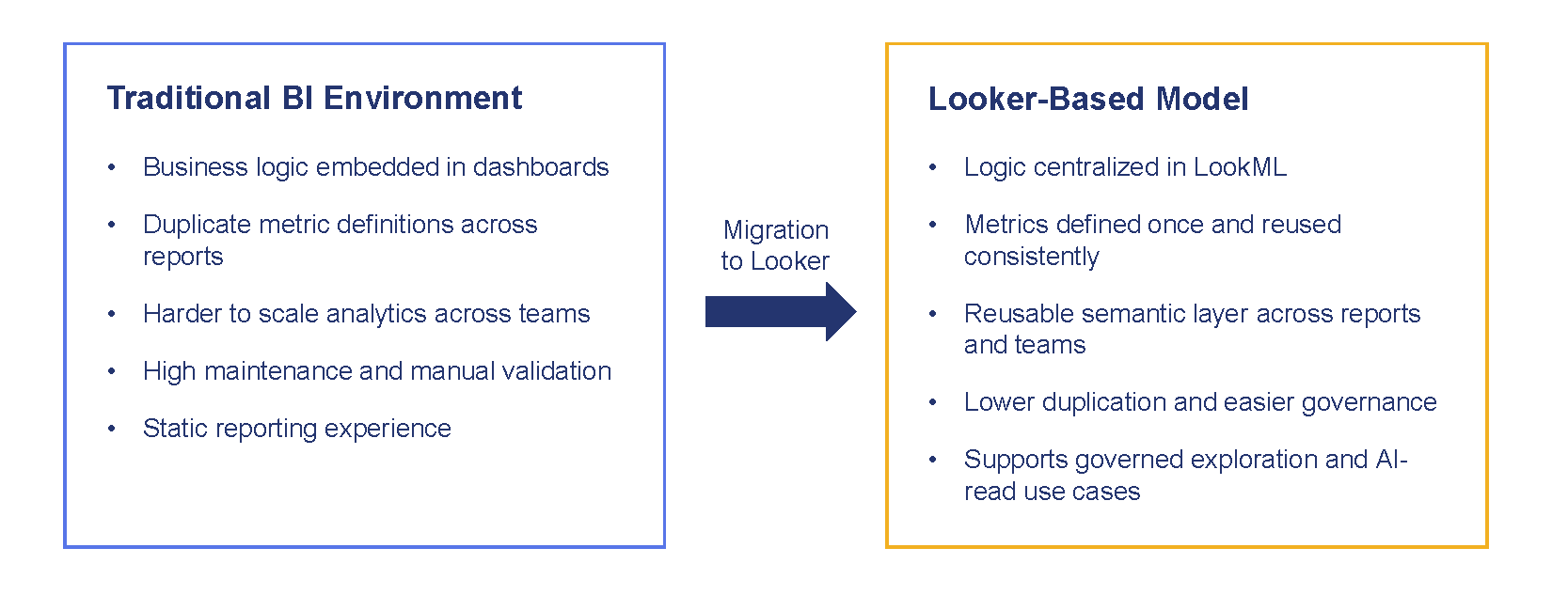
Reframing the objective from dashboards to metrics
For migration to deliver real impact, the objective needs to shift.
The goal is not to move dashboards.
The goal is to establish a governed, reusable layer of business logic.
From Dashboards to Governed Metrics
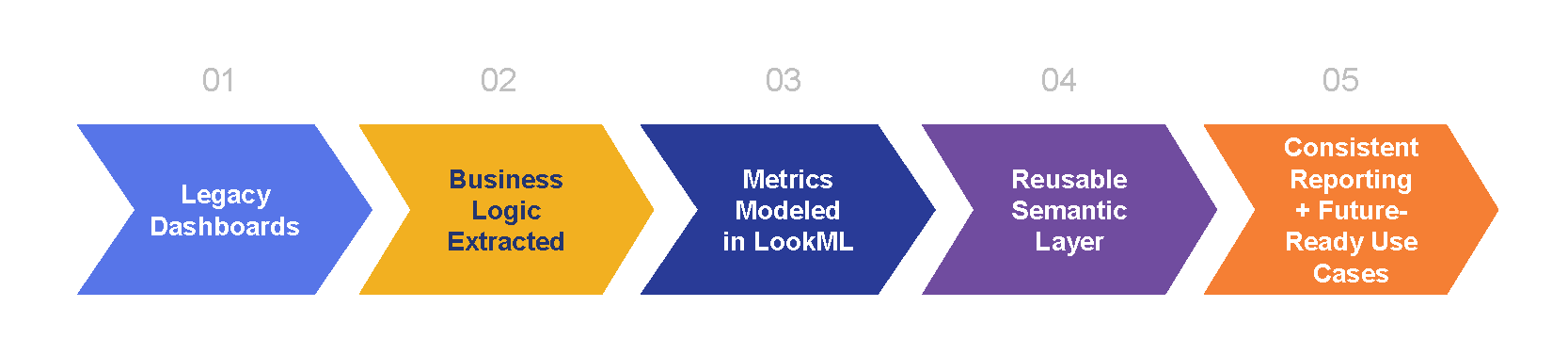
This is where Looker fundamentally changes the equation.
By centralizing logic in LookML, organizations can:
- Define metrics once and reuse them across the organization
- Ensure consistency across reports, teams, and use cases
- Separate data logic from visualization, reducing duplication
This model introduces discipline. It also introduces complexity.
Extracting business logic from Tableau and Power BI dashboards and translating it into structured LookML models is not a trivial exercise. For a deeper look at how Tableau dashboards can be efficiently converted to Looker, see our detailed guide.
The transition requires understanding dependencies, reconciling inconsistencies, and restructuring how data is consumed.
This is precisely where BI migration automation becomes essential.
Where automation actually creates leverage
Automation in migration is often positioned as a way to move faster.
Speed matters. But the deeper value lies in reducing uncertainty and enabling consistent execution at scale. Here’s a deeper breakdown of how automated BI migration reduces project risk in large-scale transformations.
Effective dashboard migration automation introduces structure into what is otherwise a highly manual process.
It changes how migration is approached across four key areas.
A structured approach to automated BI migration
Illustrative migration flow for planning and execution
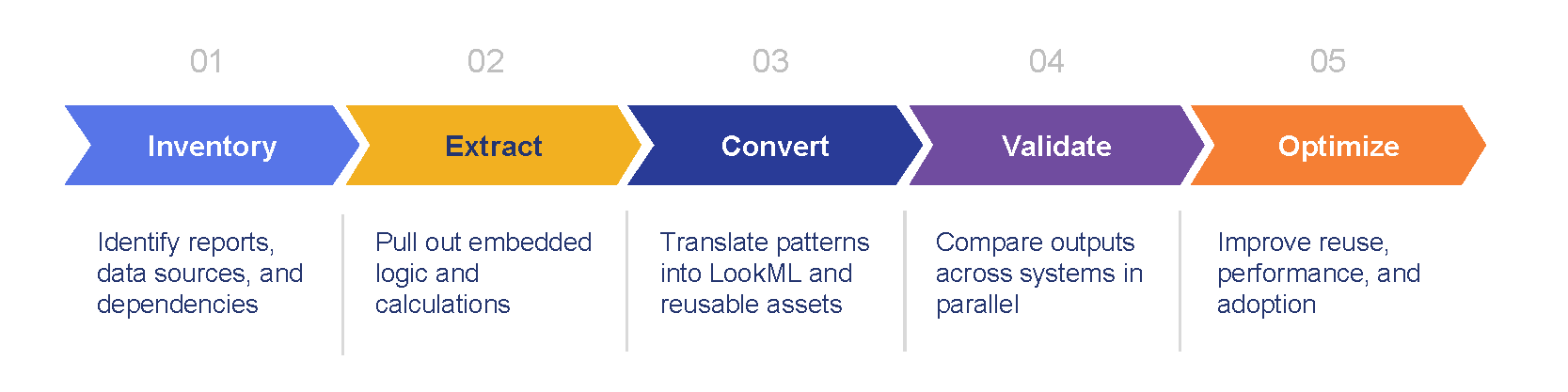
- Systematic discovery
Instead of relying on manual inventories, automation creates a comprehensive view of the existing environment.
This includes:
1. Dashboards and reports
2. Underlying queries and data sources
3. Dependencies between assets
This visibility eliminates guesswork and ensures that critical components are not overlooked. Learn more about why discovery and pre-migration analysis are critical to successful BI migration.
- Structured logic extraction
In legacy BI environments, business logic is often embedded within dashboards.
Automation enables this logic to be extracted, analyzed, and prepared for standardization. This is a critical step in building a reliable semantic layer.
- Accelerated conversion
Repetitive tasks such as translating calculations and recreating common patterns can be handled programmatically.
This reduces manual effort and minimizes the risk of human error.
- Parallel validation
One of the most time-consuming aspects of migration is validation.
Automation allows outputs to be compared across systems simultaneously, significantly reducing validation cycles while maintaining accuracy. Read more about best practices for validating dashboards after migration to Looker.
The outcome is not just faster execution.
It is a more controlled, predictable migration process.
While automation provides the framework, enterprise-scale migration requires purpose-built BI migration tools.
This is where EZConvertBI for Looker becomes relevant.
EZConvertBI is designed specifically for organizations moving from Tableau and Power BI to Looker, where both semantic accuracy and speed are critical.
Its value lies in how it addresses the most common bottlenecks in migration.
Reducing dependence on manual interpretation
Traditional migration approaches rely heavily on SMEs to interpret dashboard logic.
EZConvertBI automates metadata extraction and analysis, reducing dependency on individual knowledge and accelerating early phases of the migration.
- Streamlining LookML conversion
The transition to LookML is often the most resource-intensive part of the process.
EZConvertBI translates existing logic into structured models, enabling faster creation of reusable, governed definitions while maintaining consistency.
- Supporting rationalization
Migration should not result in a one-to-one replication of existing assets. EZConvertBI helps identify redundant and low-value dashboards, allowing organizations to streamline their BI environment as part of the transition.
- Strengthening validation
Automated validation frameworks compare outputs between source and target systems, reducing discrepancies and increasing confidence in the migrated environment.
In practice, EZConvertBI bridges the gap between the idea of automated BI migration and its execution at scale.
What faster migration actually enables
Speed is often highlighted as a primary benefit of automation.
But speed, in isolation, is not the objective.
The real value lies in what faster migration makes possible.
When supported by structured execution, faster migration enables:
- Shorter transition periods, reducing the cost of running parallel systems
- Earlier consolidation of BI tools, lowering overall operational overhead
- Faster alignment on standardized metrics across the organization
- Quicker activation of new use cases, including AI and advanced analytics
Equally important, it reduces the risk of migration fatigue.
Long-running programs tend to lose momentum. Stakeholder engagement drops. Costs increase without visible progress.
A structured, accelerated approach helps maintain focus and deliver outcomes within a predictable timeframe.
What should and should not be migrated
One of the most overlooked aspects of migration is scope control.
Not everything in the existing environment needs to move.
In fact, migrating everything often recreates the same complexity in a new system.
A disciplined approach, supported by BI migration tools, focuses on:
- Prioritization of high-value assets
Dashboards that directly influence business decisions should take precedence
- Selective rebuilding
Complex or poorly designed dashboards can be restructured to align with Looker’s model
- Elimination of redundancy
Low-usage or duplicate dashboards can be retired, simplifying the overall environment
This ensures that migration leads to simplification, not replication.
The architectural outcome and why it matters beyond BI
The long-term value of migrating to Looker is not limited to reporting.
It lies in the architecture that emerges.
| Migration Focus | Legacy BI Approach | Looker-Centered Approach |
|---|---|---|
| Metric Definition | Embedded in individual dashboards | Defined centrally in LookML |
| Reuse | Limited reuse across teams | High reuse through shared semantic logic |
| Consistency | Varies by report or team | Standardized across reports and use cases |
| Maintenance | Repetitive manual effort | Streamlined through shared logic |
| Future Readiness | Report-centric environment | Supports AI, advanced analytics, and governed exploration |
A centralized semantic layer becomes:
- The single source of truth for business metrics
- The foundation for consistent reporting across teams
- A shared layer that connects BI, data engineering, and data science
This has direct implications for scalability.
New use cases no longer require redefining metrics from scratch. Data products can be developed more efficiently. AI models can rely on consistent, well-defined inputs.
In this context, automated BI migration is not just about transitioning platforms.
It is about enabling a unified data foundation that supports long-term innovation.
Common pitfalls that undermine migration efforts
Even with automation, certain challenges can limit the success of migration initiatives.
Some of the most common include:
- Treating automation as a substitute for strategy
Automation accelerates execution but does not replace the need for governance and architectural clarity
- Underinvesting in semantic layer design
Poorly structured LookML models can recreate the same issues found in legacy systems
- Over-migrating
Moving all assets without rationalization leads to unnecessary complexity
- Lack of alignment on metrics
Without agreement on definitions, inconsistencies persist regardless of the platform
Recognizing these pitfalls early helps ensure that migration delivers both immediate and sustained value.
Conclusion
Moving from Tableau or Power BI to Looker is often positioned as a technology upgrade.
In practice, it is something more fundamental.
It is an opportunity to reset how data is defined, governed, and consumed across the organization.
Automated BI migration enables this transition with greater speed and control. It reduces execution risk by bringing structure to how dashboards and underlying logic are migrated, while purpose-built BI migration tools like EZConvertBI ensure that complexity is managed rather than carried forward
At Wavicle, migration is approached as a structured transformation rather than a lift-and-shift exercise. The focus is on combining automation with clear architectural principles to create an analytics environment that is consistent, scalable, and ready for future use cases.
Because the goal is not simply to move dashboards faster.
It is to build a foundation that allows the business to move faster.
WIT Leader

Data Team
Builds secure, governed data platforms that power analytics and feed AI models with clean, real-time, and high-quality data.
View all my PostsRelated Posts






















- Blog
- Automated ETL Migration
- AWS Glue
ETL Migration Cost Optimization: Legacy ETL to ...
-
24 Apr 2026
-
10 min read


- Blog
- Azure
- Databricks
Enabling Near Real-Time Operational Decision-Ma...
-
24 Feb 2026
-
5 min read





- Blog
- Advanced Analytics
- Healthcare
Computer Vision for Health: Living Longer
-
07 Jul 2025
-
16 min read


- Blog
- Amazon Quicksight
- BI Reporting & Visualizations
5 Major Benefits of Amazon Quick Suite That you...
-
28 May 2025
-
3 min read


- Blog
- Amazon Quicksight
- BI Reporting & Visualizations
Tips and Tricks to Get the Most Out of Amazon Q...
-
07 May 2025
-
4 min read

- Blog
- Data Governance
- Healthcare
Rethinking Healthcare Data Governance: From Sil...
-
05 May 2025
-
3 min read


- Blog
- Data Management
- Healthcare
Building the Future of Healthcare Through Flawl...
-
02 May 2025
-
4 min read

- Blog
- Environmental Social & Governance (ESG)
Leveraging AI to Optimize Energy Consumption of...
-
30 Apr 2025
-
18 min read

- Blog
- Advanced Analytics
- Predictive Modeling
Predicting the Unpredictable: Leveraging AI to ...
-
11 Apr 2025
-
3 min read


- Blog
- Demand Forecasting
- Retail
The AI Storefront: How Retail and CPG Leaders C...
-
28 Mar 2025
-
2 min read


- Blog
- Advanced Analytics
When and Where GenAI Actually Makes Sense in Kn...
-
28 Mar 2025
-
16 min read


- Blog
- Advanced Analytics
- Retail
Navigating Ethical Issues of AI in Retail
-
12 Mar 2025
-
4 min read

- Blog
- Advanced Analytics
- Generative AI & LLM
How Generative AI is Transforming Retail Custom...
-
12 Mar 2025
-
5 min read


- Blog
- Data Governance
Back to Basics: Essentials for Product Developm...
-
20 Feb 2025
-
23 min read


- Blog
- Advanced Analytics
- Generative AI & LLM
How Text Analytics and Generative AI Are Unlock...
-
09 Jan 2025
-
5 min read

- Blog
- BI Reporting & Visualizations
- Business Intelligence & Insights
Transforming BI Reporting and Visualization Wit...
-
06 Jan 2025
-
5 min read

- Blog
- Cloud Infrastructure Modernization
- Platform Management
Mastering Cloud Cost Optimization for a More Ef...
-
03 Jan 2025
-
5 min read

- Blog
- Advanced Analytics
- Generative AI & LLM
How Generative AI is Transforming the Retail Ex...
-
20 Dec 2024
-
21 min read

- Blog
- Advanced Analytics
Preparing your Business for an AI-Driven Future
-
19 Dec 2024
-
10 min read

- Blog
- Advanced Analytics
What it Means to be Human in the Age of AI
-
12 Dec 2024
-
18 min read

- Blog
- Business Intelligence & Insights
- Reporting Modernization
How EZConvertBI Simplifies Your Looker Migration
-
12 Dec 2024
-
4 min read

- Blog
- Advanced Analytics
- Business Intelligence & Insights
Transforming Business Intelligence with Looker
-
12 Dec 2024
-
6 min read

- Blog
- Advanced Analytics
- Data Governance
Key Challenges in AI Adoption for Businesses
-
11 Dec 2024
-
13 min read

- Blog
- Advanced Analytics
- Generative AI & LLM
What AI Disruption Means for Businesses
-
05 Dec 2024
-
15 min read

- Blog
- Advanced Analytics
- Business Intelligence & Insights
Optimizing Your Cloud Data Platform with Google...
-
04 Dec 2024
-
7 min read

- Blog
- Advanced Analytics
- Amazon Quicksight
From Shopfloor to Boardroom: Get Your Data to T...
-
21 Nov 2024
-
5 min read


- Blog
- BI Reporting & Visualizations
- Build & Migrations
Let Your Data Speak to You – Unlocking Organiza...
-
12 Nov 2024
-
5 min read

- Blog
- Advanced Analytics
- Business Analytics
The Joy of Decision-Making and Why It Matters
-
12 Nov 2024
-
5 min read

- Blog
- Data Management
- Strategy & Assessments
Understanding Data Products
-
11 Nov 2024
-
4 min read

- Blog
- Advanced Analytics
- Generative AI & LLM
Crafting User-Focused Solutions and Building an...
-
06 Nov 2024
-
12 min read

- Blog
- Architecture & Engineering
- Cloud Infrastructure Modernization
How Data Mesh is Shaping the Future of Data Man...
-
05 Nov 2024
-
8 min read

- Blog
- Business Intelligence & Insights
- Reporting Modernization
Streamline your Power BI Migration with EZConve...
-
22 Oct 2024
-
4 min read

- Blog
- Advanced Analytics
Maximizing Business Transformation Through AI a...
-
15 Oct 2024
-
18 min read

- Blog
- Advanced Analytics
- BI Reporting & Visualizations
How Gen AI and Microsoft Copilot are Reshaping ...
-
03 Oct 2024
-
5 min read

- Blog
- Advanced Analytics
- Build & Migrations
Transforming Data Capabilities by Moving Beyond...
-
25 Sep 2024
-
5 min read

- Blog
- Business Analytics
- Business Intelligence & Insights
How to Build a Restaurant Performance Measureme...
-
24 Sep 2024
-
6 min read

- Blog
- Advanced Analytics
- Business Analytics
Leveraging Data Science and AI to Drive Innovat...
-
16 Sep 2024
-
16 min read

- Blog
- Advanced Analytics
- Generative AI & LLM
The Role of Mature Data and AI in Accurate Gene...
-
26 Aug 2024
-
14 min read

- Blog
- Advanced Analytics
- Business Analytics
Listening to the Voice of the Customer: A Key t...
-
21 Aug 2024
-
6 min read

- Blog
- Azure
- BI Reporting & Visualizations
Moving from Tableau to Power BI: Why Companies ...
-
20 Aug 2024
-
6 min read

- Blog
- Advanced Analytics
How AI Impacts the Ways We Develop and Grow Dat...
-
14 Aug 2024
-
18 min read

- Blog
- Advanced Analytics
- Demand Forecasting
How to Use Demand Forecasting to Improve Busine...
-
12 Aug 2024
-
6 min read


- Blog
- Business Intelligence & Insights
- Cloud Infrastructure Modernization
Building a Data Platform on Snowflake
-
01 Aug 2024
-
5 min read

- Blog
- Advanced Analytics
- Demand Forecasting
Why Your Demand Forecasting Model Doesn’t Work ...
-
30 Jul 2024
-
7 min read

- Blog
- Advanced Analytics
- Data Governance
Expert Insights on Demonstrating the Value of D...
-
22 Jul 2024
-
9 min read

- Blog
- Advanced Analytics
- Generative AI & LLM
How to Effectively Harness Gen AI for Your Busi...
-
18 Jul 2024
-
5 min read

- Blog
- Advanced Analytics
- Generative AI & LLM
Navigating the AI Hype Cycle by Setting Realist...
-
11 Jul 2024
-
15 min read

- Blog
- Advanced Analytics
- Data Management
Leveraging AI Technology in Healthcare
-
10 Jul 2024
-
17 min read

- Blog
- Advanced Analytics
- Data Governance
Expert Insights on Leveraging Data Quality and ...
-
01 Jul 2024
-
8 min read

- Blog
- Data Governance
- Privacy Governance & Compliance
Choosing the Right Data Governance Approach for...
-
24 Jun 2024
-
5 min read

- Blog
- Data Governance
- Privacy Governance & Compliance
Expert Insights on Leveraging Data Governance f...
-
11 Jun 2024
-
12 min read

- Blog
- Data Governance
- Data Management
The Role of Existing Data Stewards in Driving G...
-
10 Jun 2024
-
3 min read

- Blog
- Data Governance
- Data Management
Optimizing Data Governance Programs Beyond Chec...
-
03 Jun 2024
-
4 min read

- Blog
- Data Governance
- Privacy Governance & Compliance
Measuring Data Governance Progress With Metrics...
-
29 May 2024
-
4 min read

- Blog
- Data Governance
- Data Management
Decoding Data Governance: Going Beyond its Name
-
22 May 2024
-
5 min read

- Blog
- Business Analytics
- Business Intelligence & Insights
How Your Data Governance Strategy Supports Data...
-
15 May 2024
-
4 min read

- Blog
- Data Governance
- Privacy Governance & Compliance
The Need for Data Governance in a Changing World
-
13 May 2024
-
4 min read

- Blog
- Manufacturing
How Smart Manufacturing and Digital Twins Are H...
-
06 May 2024
-
6 min read

- Blog
- Advanced Analytics
- Data Management
Crafting a Data Strategy to Support AI in Healt...
-
30 Apr 2024
-
13 min read


- Blog
- Data Management
- Data Privacy & Regulatory Compliance
How to Achieve Compliance Excellence in Healthc...
-
24 Apr 2024
-
5 min read


- Blog
- Environmental Social & Governance (ESG)
- Manufacturing
Modernizing Supply Chains for Resilience and Su...
-
17 Apr 2024
-
8 min read

- Blog
- Advanced Analytics
- Business Analytics
Getting the Absolute Best Data Science Talent t...
-
16 Apr 2024
-
14 min read

- Blog
- Architecture & Engineering
- Data Management
How to Design a Modern Data Architecture
-
10 Apr 2024
-
5 min read

- Blog
- Advanced Analytics
- Predictive Modeling
How to Re-imagine Customer Experience With Pred...
-
10 Apr 2024
-
4 min read

- Blog
- Advanced Analytics
- Generative AI & LLM
Expert Insights on Transformative AI Strategies...
-
10 Apr 2024
-
13 min read

- Blog
- Data Management
- Strategy & Assessments
Why Your Organization Needs a Data Strategy
-
01 Apr 2024
-
4 min read

- Blog
- Data Management
- Strategy & Assessments
Getting Started With Data Strategy: The AI-Led ...
-
28 Mar 2024
-
3 min read

- Blog
- Cloud Infrastructure Modernization
- Cloud Security & Monitoring
The Role of AI and ML in Cloud Security Monitoring
-
21 Mar 2024
-
4 min read

- Blog
- Data Management
- Strategy & Assessments
Getting Started With Data Strategy: The Acceler...
-
20 Mar 2024
-
4 min read

- Blog
- Advanced Analytics
The Role of the Chief AI Officer (CAIO)
-
15 Mar 2024
-
13 min read

- Blog
- Data Management
- Strategy & Assessments
Getting Started With Data Strategy: The Traditi...
-
13 Mar 2024
-
4 min read

- Blog
- Healthcare
- Strategy & Assessments
How Building a Strong Data Strategy Boosts Heal...
-
12 Mar 2024
-
7 min read

- Blog
- Data Management
- Strategy & Assessments
The Do’s and Don’ts of Data Strategy
-
06 Mar 2024
-
6 min read

- Blog
- Advanced Analytics
- Manufacturing
The Role of Advanced Analytics and AI in Reduci...
-
04 Mar 2024
-
5 min read

- Blog
- Advanced Analytics
- Data Management
Reducing Barriers to Complex Data Science Entry...
-
15 Feb 2024
-
14 min read


- Blog
- Amazon Quicksight
- AWS
Mastering the Art of Visual Storytelling: Wavic...
-
29 Jan 2024
-
1 min read

- Blog
- Amazon Quicksight
- AWS
Getting to Know the Tableau-to-Amazon Quick Sui...
-
29 Jan 2024
-
3 min read


- Blog
- Manufacturing
Manufacturing Metrics That Elevate Performance ...
-
24 Jan 2024
-
8 min read

- Blog
- Restaurant
Mastering the Increasingly Complex QSR Landscape
-
18 Jan 2024
-
3 min read

- Blog
- Advanced Analytics
- Manufacturing
Manufacturing in 2024: Key Data and Analytics T...
-
12 Dec 2023
-
8 min read

- Blog
- Advanced Analytics
- Business Analytics
Data-Driven Dining: Three Essential Data, Analy...
-
20 Nov 2023
-
7 min read

- Blog
- Healthcare
2024 Healthcare Trends: Reimagining the Industr...
-
14 Nov 2023
-
6 min read

- Blog
- Advanced Analytics
- Business Analytics
Demystifying Data and Analytics
-
24 Oct 2023
-
12 min read

- Blog
- Healthcare
Exploring Data and Analytics in Healthcare: A Q...
-
12 Oct 2023
-
7 min read


- Blog
- Advanced Analytics
- Predictive Modeling
Revolutionizing Your Customer Experience Measur...
-
04 Oct 2023
-
10 min read

- Blog
- Business Analytics
- Business Intelligence & Insights
How Integrating Reservation and POS Data Can Pr...
-
27 Sep 2023
-
4 min read

- Blog
- Advanced Analytics
- Business Intelligence & Insights
Next-Generation CDOs: A Conversation About the ...
-
25 Sep 2023
-
12 min read

- Blog
- Data Management
How Effective Data Management Helps to Realize ...
-
22 Sep 2023
-
6 min read

- Blog
- Business Intelligence & Insights
Why Data Analytics Projects Fail and How to Ove...
-
22 Sep 2023
-
5 min read


- Blog
- Advanced Analytics
- Machine Learning & MLOps
How to Build Resilient Business Strategies Usin...
-
22 Aug 2023
-
6 min read

- Blog
- Business Analytics
- Manufacturing
3 Ways Data Analytics Can Transform Your Supply...
-
01 Aug 2023
-
4 min read

- Blog
- Business Analytics
- Manufacturing
How is Data Analytics Transforming Production?
-
26 Jul 2023
-
5 min read

- Blog
- Advanced Analytics
- Predictive Modeling
5 Blockers to Effective Artificial Intelligence...
-
24 Jul 2023
-
6 min read

- Blog
- Data Governance
- Data Management
Instilling Data Quality Into Your Data Manageme...
-
20 Jul 2023
-
7 min read


- Blog
- Advanced Analytics
- Business Analytics
3 Ways Engineers Can Drive Business Value with ...
-
18 Jul 2023
-
4 min read

- Blog
- Advanced Analytics
- Predictive Modeling
Calculating ROI for Advanced Analytics Initiatives
-
15 Jul 2023
-
6 min read

- Blog
- Data Management
- Strategy & Assessments
How Business Leaders Leverage Data as a Critica...
-
15 Jun 2023
-
7 min read

- Blog
- Amazon Quicksight
- BI Reporting & Visualizations
Clear and Actionable: Wavicle’s Winning Dashboard
-
09 May 2023
-
2 min read

- Blog
- Cloud Infrastructure Modernization
- Platform Management
The Importance of Effective Cloud Platform Mana...
-
07 May 2023
-
4 min read

- Blog
- Data Management
How Businesses Benefit from Modern Data Managem...
-
02 May 2023
-
7 min read

- Blog
- Architecture & Engineering
- Data Management
Data Architecture 101: Trends and Terms to Know
-
25 Apr 2023
-
6 min read

- Blog
- Restaurant
Building a Contact-Free Smart System
-
20 Apr 2023
-
2 min read


- Blog
- Build & Migrations
- Data Management
Which Data Storage Solution is Right for Your O...
-
04 Apr 2023
-
6 min read

- Blog
- Manufacturing
What’s Next in Manufacturing? A Q&A With T...
-
02 Mar 2023
-
4 min read


- Blog
- Data Governance
Governing Your Data: How to Start Designing a G...
-
14 Feb 2023
-
3 min read

- Blog
- Data Governance
Data Governance Roles: Who Should Govern Your D...
-
07 Feb 2023
-
4 min read

- Blog
- Financial Services
Financial Services Executive Outlook: The Benef...
-
02 Feb 2023
-
3 min read


- Blog
- Financial Services
Financial Services Executive Outlook: The Path ...
-
26 Jan 2023
-
4 min read

- Blog
- Data Governance
The Path to Data Governance: What Data Will Be ...
-
24 Jan 2023
-
3 min read

- Blog
- ActiveInsights
- Advanced Analytics
The Future of Voice of Customer: 5 Trends to Watch
-
18 Jan 2023
-
8 min read

- Blog
- Financial Services
Financial Services Executive Outlook: Capitaliz...
-
12 Jan 2023
-
4 min read

- Blog
- Data Governance
What is a Customer? How Simple Questions Get Co...
-
05 Jan 2023
-
6 min read

-
29 Nov 2022
-
7 min read


- Blog
- Data Governance
- Data Privacy & Regulatory Compliance
Why a Good Governance, Privacy, and Compliance ...
-
08 Nov 2022
-
7 min read


- Blog
- Data Governance
Data Governance for Business Leaders: 3 Concept...
-
25 Oct 2022
-
5 min read


- Blog
- Financial Services
Financial Services Executive Outlook: The Impac...
-
29 Sep 2022
-
2 min read


- Blog
- Financial Services
Financial Services Executive Outlook: The Reali...
-
22 Sep 2022
-
3 min read


- Blog
- Augment
- AWS
ETL Modernization: Reduce Migration Timelines a...
-
02 Mar 2022
-
4 min read

- Blog
- Advanced Analytics
- Machine Learning & MLOps
Five Steps To Operationalizing Advanced Analyti...
-
24 Nov 2021
-
5 min read

- Blog
- Augment
- Data Privacy & Regulatory Compliance
A New Way to Quickly and Easily Discover PII Da...
-
19 Oct 2021
-
2 min read

- Blog
- Architecture & Engineering
- Augment
6 Reasons You Need an Augmented Data Quality So...
-
16 Sep 2021
-
5 min read

- Blog
- ActiveInsights
- Business Analytics
Ditch the Survey and Really Get to Know Your Cu...
-
15 Jul 2021
-
8 min read

- Blog
- Architecture & Engineering
- Business Analytics
Five Reasons Why Boutique Consulting Firms Are ...
-
21 Jun 2021
-
6 min read

- Blog
- Advanced Analytics
- Machine Learning & MLOps
Deep Multi-Input Models Transfer Learning For I...
-
14 Jun 2021
-
15 min read

- Blog
- Advanced Analytics
- Machine Learning & MLOps
Deep Learning For Natural Language Processing o...
-
08 Jun 2021
-
9 min read

- Blog
- ActiveInsights
- Customer 360
5 Ways to Successfully Win Travelers’ Loy...
-
25 May 2021
-
6 min read

- Blog
- Business Analytics
- Business Intelligence & Insights
Want to Meet Consumer Expectations? Demand Fore...
-
25 May 2021
-
9 min read

- Blog
- Advanced Analytics
- Customer 360
These 3 Top Retail Analytics Trends are Revolut...
-
25 May 2021
-
7 min read

- Blog
- Demand Forecasting
Demand Forecasting Is Always Wrong: Three Ways ...
-
27 Apr 2021
-
5 min read

- Blog
- Architecture & Engineering
- Business Analytics
8 CDOs Share Key Insights on How to Build a Suc...
-
23 Apr 2021
-
6 min read

- Blog
- Business Analytics
- Business Intelligence & Insights
Here’s Why 2021 is Actually the First “Year of ...
-
07 Apr 2021
-
10 min read

- Blog
- Advanced Analytics
- Business Analytics
Five Critical Elements For Successful Customer ...
-
17 Feb 2021
-
5 min read

- Blog
- Architecture & Engineering
- Business Analytics
Everything You Need to Know About Data & A...
-
15 Jan 2021
-
5 min read

- Blog
- Business Intelligence & Insights
- Data Management
What Happens When Insurers Turn to Data Analytics?
-
04 Jan 2021
-
4 min read

- Blog
- Architecture & Engineering
- Data Management
What Happens When ERP Systems Talk? The Results...
-
04 Jan 2021
-
5 min read

- Blog
- Data Management
- Data Privacy & Regulatory Compliance
Compliance Data Management: the Case For Automa...
-
02 Dec 2020
-
5 min read

- Blog
- Architecture & Engineering
- Data Management
Compliance Data Management: Data Preparation Sa...
-
02 Dec 2020
-
7 min read

- Blog
- Business Analytics
- Customer 360
Your Customers Like You, They Really, Really Li...
-
25 Aug 2020
-
9 min read

- Blog
- Predictive Modeling
- Restaurant
Why Micro-Segmentation Matters in a Post-COVID ...
-
10 Aug 2020
-
6 min read

- Blog
- Architecture & Engineering
- Data Management
Data Architecture From Right to Left: Start Wit...
-
18 May 2020
-
6 min read

- Blog
- Business Analytics
- Business Intelligence & Insights
Using Big Data to Better Predict Your Recovery:...
-
11 May 2020
-
8 min read


- Blog
- Cloud Infrastructure Modernization
- Data Management
How to Get Faster, More Reliable Analytics from...
-
04 Dec 2019
-
7 min read

- Blog
- ActiveInsights
- Architecture & Engineering
Take Ownership of the Relationship with Your Di...
-
04 Dec 2019
-
4 min read

- Blog
- ActiveDeliver
- Business Intelligence & Insights
Food Delivery: Who Owns the Customer?
-
05 Nov 2019
-
5 min read


- Blog
- Business Analytics
- Business Intelligence & Insights
Quick Service Restaurants are Ravenous for Big ...
-
03 Apr 2019
-
4 min read

- Blog
- Architecture & Engineering
- Data Management
CDO Summit Key Takeaways
-
02 Apr 2019
-
7 min read

- Blog
- Advanced Analytics
- BI Reporting & Visualizations
2019 Business Intelligence Trends
-
16 Oct 2018
-
3 min read


