31 Dec 2025
 7 min read


A food chain cooks up conversion with personalized offers that sizzle
This article is based on a recent TDWI webinar, “Microsegmentation: What Is It, And Why It Is Important in a Post-Covid World,” sponsored by Talend and Databricks (June 3, 2020).
If you are a brand marketer or member of a customer analytics team, you might already use micro-segmentation as a way to reach and engage your best customers efficiently. If you don’t, let’s explore why micro-segmentation matters, especially now – a time when bringing back consumers is crucial to your company’s rebound and future growth.
What is micro-segmentation?
Micro-segmentation is the process used to create hundreds or thousands of specific groups of customers, enabling companies to interact with them in more customized and personalized ways. It breaks up large customer clusters created from traditional macro-segmentation techniques, which group customers based on geographic, demographic, behavioral, or psychographic attributes. Usually, the goal is to uncover which type of customer spends the most money, so targeted communications and offers can be made directly to them.
Micro-segmentation is more granular than macro-segmentation. It combines attributes to pinpoint smaller subgroups of even higher value. Using a hybrid of factors is the best way to identify who your best customers are, how they behave, and what matters most to them. This involves bringing disparate data sources together, then applying sophisticated analytics to identify not only who spends the most now, but who likely will in the future, too. This is an example of how predictive analytics and machine learning are playing more important roles within companies.
Predictive analytics and machine learning go mainstream
Most companies seek to improve their decision-making with better insight. Now new research highlights the relevance of deeper analytics: according to TDWI, a majority of corporate analytics departments say they want to increase their predictive analytics and machine learning capabilities.
Among 109 respondents of TDWI’s 2020 Data and Analytics Survey, a resounding 71% say demand for deeper analytics has increased internally, up from 64% last year. Putting this demand into action, about one-third of respondents say they are actively building predictive analytics and machine learning models within their organizations, with at least some projects underway. Common use cases for advanced analytics include customer churn, behavior and sentiment analysis, next-best action, recommendation engines, targeted marketing/advertising, personalization, customer experience, and more.
COVID-19 changes everything, including analytics
The business slowdown resulting from Coronavirus has given corporate analytics teams a chance to begin taking action on strategic data initiatives. But Fern Halper, TDWI’s Vice President and Senior Research Director for Advanced Analytics, cautions that while teams may be excited to dig in, the business landscape is no longer the same. “Teams are being asked to help organizations tune their analytics to fit the changing circumstances,” says Halpern.
To Halpern’s point, more than 50% of respondents say they are being tasked with answering new kinds of questions based on COVID’s economic impact on their company. TDWI’s survey also finds that about 30% need to update their models due to changing customer behaviors, and another 30% are required to add new data sources.
“We’re hearing that it’s more important than ever to understand the behavioral changes of your customers,” says Halpern. “Machine learning is used for grouping customers into specific segments based on common characteristics, enabling targeted communications and personalization. So even if you do segmentation now, it’s a good time to revisit this.”
What micro-segmentation looks like for a major restaurant brand
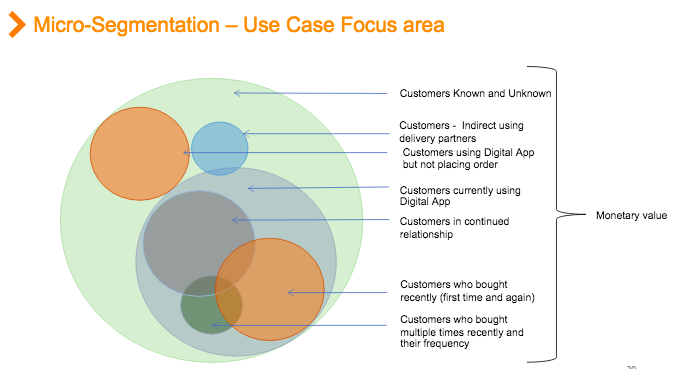
Recently, Wavicle Data Solutions helped a restaurant chain successfully segment its customer data into sub-groups that share behavioral characteristics with other attributes. First, we broke the total customer universe down into two groups:
- “Known” customers, for whom some level of personal data exists
- “Unknown” customers, who are anonymous – no personal data exists
Focusing on known customers, the biggest group is people who had ordered food using the restaurant’s mobile app. We then segmented this group into additional clusters such as:
- Customers who began ordering food online recently, and then bought again
- Customers who ordered food multiple times in the recent past
- Customers in a continued relationship with the restaurant chain, who have not purchased recently