04 May 2026
 5 min read


Manufacturing leaders are not debating whether AI in manufacturing matters anymore. That debate is over.
What they are wrestling with now is a much harder question: how do you move from interest to AI execution?
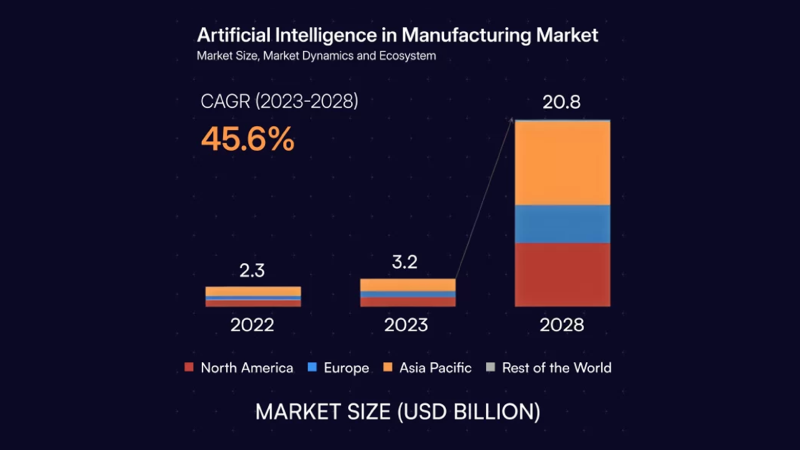
That is where the real market gap is opening up. Redwood Software’s 2026 manufacturing AI and automation research found that 98% of manufacturers are exploring or considering AI‑driven automation, yet only 20% say they feel fully prepared to use it at scale. At the same time, IDC predicts that by 2026, more than 40% of manufacturers with a production scheduling system in place will upgrade it with AI‑driven capabilities to start enabling autonomous processes. Together, those two signals tell the story. The market is moving fast, but operational readiness is lagging behind.
This article examines why that readiness gap exists, why so many AI initiatives stall between interest and execution, and what manufacturers need to change to move from experimentation to execution at scale.
That lag is not just a technology problem. It is a business problem.
Why So Many AI Efforts Stall After Early Success
Over the last two years, many manufacturers have approached AI in manufacturing as a technology selection exercise.
- Which platform should we standardize on?
- Which model performs best?
- Which assistant is the smartest?
- Which agent framework should we test first?
These are fair questions. However, they are rarely the reason AI initiatives succeed or fail.
Most programs stall not because the technology underperforms but because the organization around it cannot absorb, trust, or act on what AI produces. This is why so many initiatives never move beyond a successful demo.
The real issue is whether the business can trust the data, operationalize insight, and act fast enough for AI to matter.
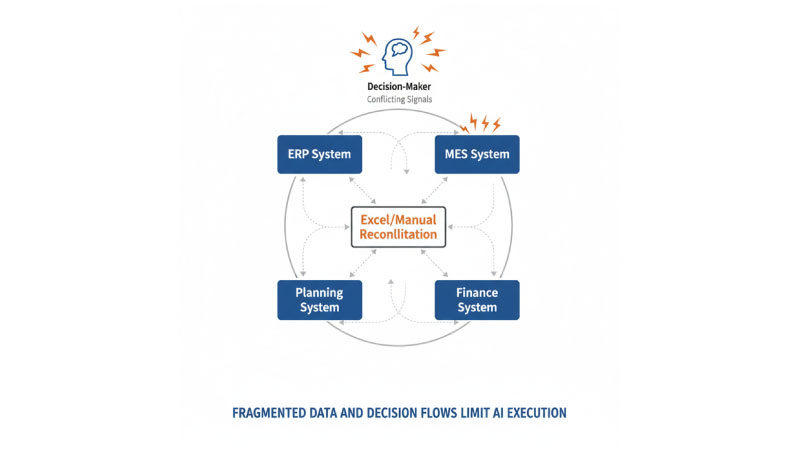
In most manufacturing environments, the signals required to make better decisions remain fragmented. ERP reflects one version of the truth. MES reflects another. Excel is still reconciling both.
Planning operates on one cadence. Operations operate on another. Finance operates on a third. Teams are asked to move faster, but the operating model underneath remains batch‑driven and dependent on manual interpretation.
So when manufacturers say they are “not ready,” they rarely lack ambition. They are describing a lack of execution infrastructure.
What the Readiness Gap Looks Like in Practice
This readiness gap shows up in very practical ways.
Many organizations still lack a governed data foundation that gives AI reliable business context. They lack manufacturing‑specific workflows that guide where AI should focus and when escalation is required. They lack an operating model that connects insight to action across planning, production, procurement, logistics, and finance.
Without these elements, AI outputs may appear impressive, but they remain disconnected from daily execution.
This is the readiness gap. It is also where the next wave of competitive advantage will be created.
The manufacturers closing this gap are not starting with massive AI transformations. They are starting with one decision that truly matters.
This might be a planning bottleneck that forces repeated last‑minute inventory moves. It might be a recurring supply chain exception that consistently disrupts service levels. It might be a production decision that relies too heavily on tribal knowledge instead of real‑time signals. It might be a margin leak that only becomes visible after the financial impact is already locked in.
For example, a production scheduler may use AI to flag infeasible plans before changeovers are committed. A supply chain team may identify supplier risk early enough to adjust sourcing instead of reacting after delivery failures occur.
The goal is not to “do AI.” The goal is to redesign business decisions so better data, stronger context, and faster action are built directly into the workflow.
Where Leadership Makes the Difference
Every major technology provider now has an AI story. Managed agents, copilots, orchestration layers, semantic models, and interoperability frameworks are all becoming more accessible.
As this infrastructure matures, differentiation shifts away from tooling. It shifts toward judgment.
Judgment about which manufacturing problems to solve first. Judgment about which workflows should remain human‑led and which can be automated with confidence. Judgment about how digital capability connects to real conditions on the plant floor.
Strong manufacturers will not separate themselves by having louder AI narratives. They will do so by building the operational muscle required to make AI effective in production.
In practice, manufacturers that succeed with AI in manufacturing consistently focus on three essentials.
First, they build a governed data foundation so the business can trust what AI is seeing.
Second, they anchor AI efforts in decision‑first use cases such as demand forecasting, production scheduling, supplier risk, quality exceptions, and margin protection. These are not AI projects. They are operating decisions with measurable outcomes.
Thirdly, they also treat execution as a cross‑functional discipline rather than a pilot exercise. AI creates value only when planning, operations, finance, and technology are aligned around how decisions are made and how action is triggered.
When AI is treated as a pilot, it stays a pilot. When it is treated as an operating model, it scales.
The Opportunity Ahead
Manufacturers that close the preparation gap can move faster, improve service levels, protect margins, and reduce waste caused by poor timing and fragmented execution. Manufacturers that do not will spend the next year piloting tools while better‑prepared competitors operationalize them.
The market does not need another AI demo.
It needs execution.
At Wavicle, we believe the next era of manufacturing performance will be defined by companies that connect governed data, decision‑first workflows, and practical AI delivery.
The question is no longer whether manufacturers want AI. The question is who will be ready to use it well.
Reach out to explore how Wavicle helps manufacturers operationalize AI at scale.