Over the past several years, enterprises have invested heavily in dashboards, reporting platforms, cloud modernization, and analytics programs. Access to data has improved dramatically. Yet many leadership teams still struggle to respond at the speed the business demands.
The issue is no longer visibility. It is decision consistency.
Different teams often operate from different operational signals. Finance sees one version of margin performance. Operations sees another view of cost pressure. Supply chain teams react to different inventory indicators than regional business teams.
As AI adoption increases, this problem becomes harder to ignore. AI can generate recommendations faster than ever before. But when the underlying business context is inconsistent, organizations risk accelerating confusion instead of improving responsiveness. Enterprises need to ensure the business can act from a shared operational context.
This is why enterprises need to stop treating modernization as a dashboard or infrastructure problem. The real challenge is decision consistency across analytics, governance, and AI systems. That is also why unified data and AI platforms like Databricks are becoming increasingly important. They do not just consolidate technology; they help create a shared operational foundation for enterprise decision-making.
A trusted decision engine is not just a reporting layer. It is a decision layer that brings together consistent metrics, operational context, governance, and action across the enterprise.
What is actually slowing enterprise decision-making
Most operational delays today are not caused by lack of data access. They are caused by inconsistency between the systems shaping business decisions.
That inconsistency usually appears in four areas:
- metrics are not aligned across functions
- reporting workflows become fragmented over time
- governance gaps reduce trust in AI outputs
- operational ownership becomes unclear
A supply chain disruption is a useful example. Finance, procurement, operations, and regional teams may all need to respond simultaneously. But if each team relies on different operational signals, alignment slows down precisely when the business needs coordination most.
This is why many enterprises feel operationally slower today, even after major investments in analytics modernization. The issue is not that the business cannot see enough. It is that teams cannot always act from the same version of reality.
Why modernization still fails to improve responsiveness
Most enterprises already recognize parts of this problem. They know dashboards are fragmented, KPI definitions vary across teams, governance slows AI adoption, and operational coordination is becoming harder. But many organizations still approach these as isolated issues instead of connected operating-model problems. That is where modernization efforts often stall.
The challenge is usually not awareness. It is operational inertia.
Many enterprises modernized technology faster than they modernized how decisions move through the business. As a result, organizations often end up with modern platforms, advanced AI tooling, and expanded analytics access while still carrying fragmented workflows, duplicated business logic, manual validation cycles, and disconnected operational ownership.
The dashboards improve. But the operating model does not.
Even with the right technology strategy, that keeps responsiveness from improving at the business level.
What enterprises should do differently
Improving decision-making today requires more than modernizing dashboards or migrating infrastructure.
Enterprises need to reduce fragmentation across:
- Pipelines
- Metrics
- Governance
- Analytics
- AI systems
That means creating a shared operational foundation where teams can work from consistent business signals.
This is where platforms like Databricks are becoming increasingly important.
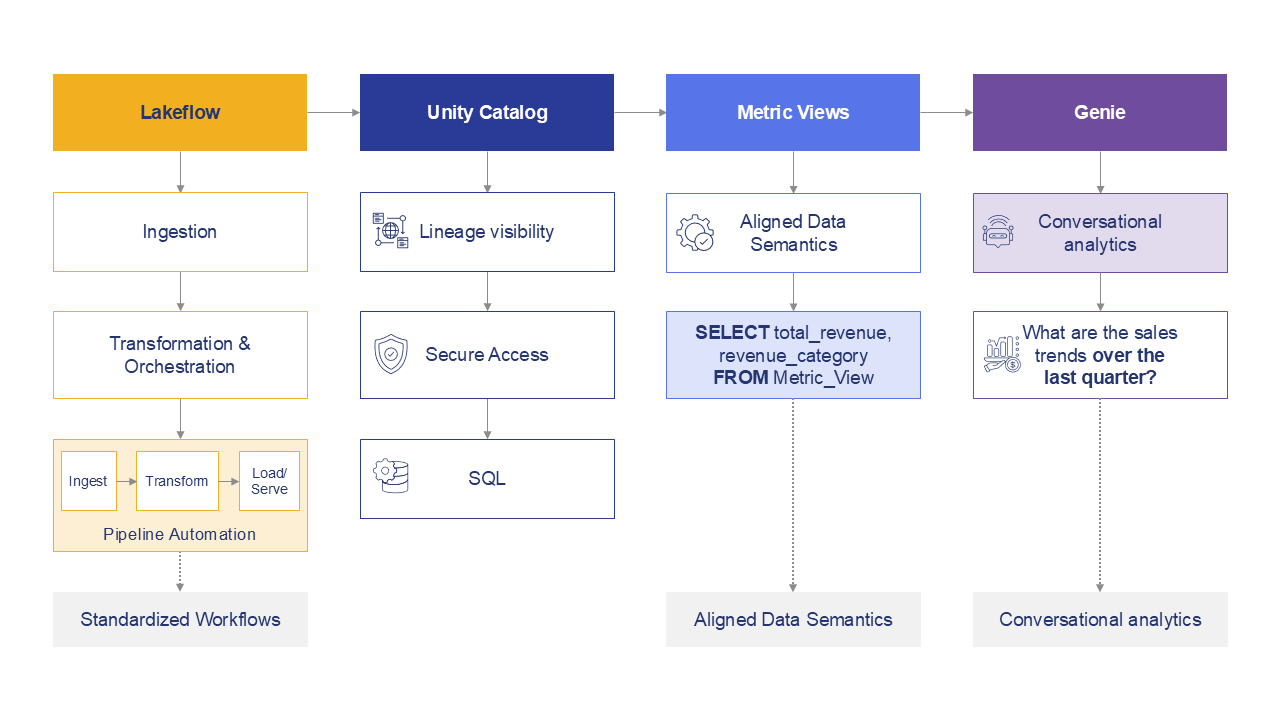
- Lakeflow helps standardize ingestion, transformation, and orchestration workflows across the enterprise.
- Unity Catalog helps create consistency around governance, lineage, access controls, and business definitions across analytics and AI environments.
- Metric Views help standardize business semantics and KPI definitions at the data layer, reducing inconsistency across dashboards, reports, and AI-driven insights.
- Genie provides a conversational interface over a governed Lakehouse semantic layer, reducing reliance on fragmented BI reports and enabling consistent operational insights.
The value of this architecture goes beyond modernization. It improves coordination.
When engineering, governance, analytics, and AI operate from a shared operational foundation, organizations reduce the friction that slows enterprise response. That becomes increasingly important as AI-driven operations expand across manufacturing, healthcare, retail, finance, and supply chain environments. AI systems are only as reliable as the foundation beneath them.
The shift enterprises need to make
The next phase of enterprise modernization is not about building more dashboards. It is about building systems that help the business make coordinated decisions faster.
That requires:
- trusted operational signals
- consistent governance
- aligned metrics
- connected workflows
- AI grounded in shared business context
The organizations that succeed will not necessarily be the ones with the largest analytics environments. They will be the ones that can reduce friction between data, operations, analytics, governance, and AI-driven decision-making. Platforms like Databricks help enterprises bring those capabilities together into a more connected operational environment. Wavicle helps enterprises operationalize that shift by aligning analytics, governance, and AI around more consistent decision-making.
Because competitive advantage no longer comes from simply seeing more data.
It comes from helping the business make faster, more coordinated, and more confident decisions across the enterprise.


 02 Jun 2026
 5 min read