Multi-platform data architecture is no longer a future state – it is the present reality for most enterprises. Organizations operating Databricks alongside Snowflake are not doing so because it is simple; they are doing it because each platform has earned its place in the stack.

But combining best-fit platforms creates a compounding problem: governance, metadata consistency, access-control synchronization, and cost visibility all become significantly harder to manage once workloads start crossing platform boundaries.

That is the problem Wavicle set out to quantify. We ran a structured interoperability POC across six enterprise use cases using Databricks, Snowflake, and Apache Iceberg to determine whether multi-platform is not just technically possible, but governable, cost-defensible, and operationally sustainable at scale.

Key finding: Interoperability is not a feature to enable. It is an operating model to design, measure, and govern before you scale.

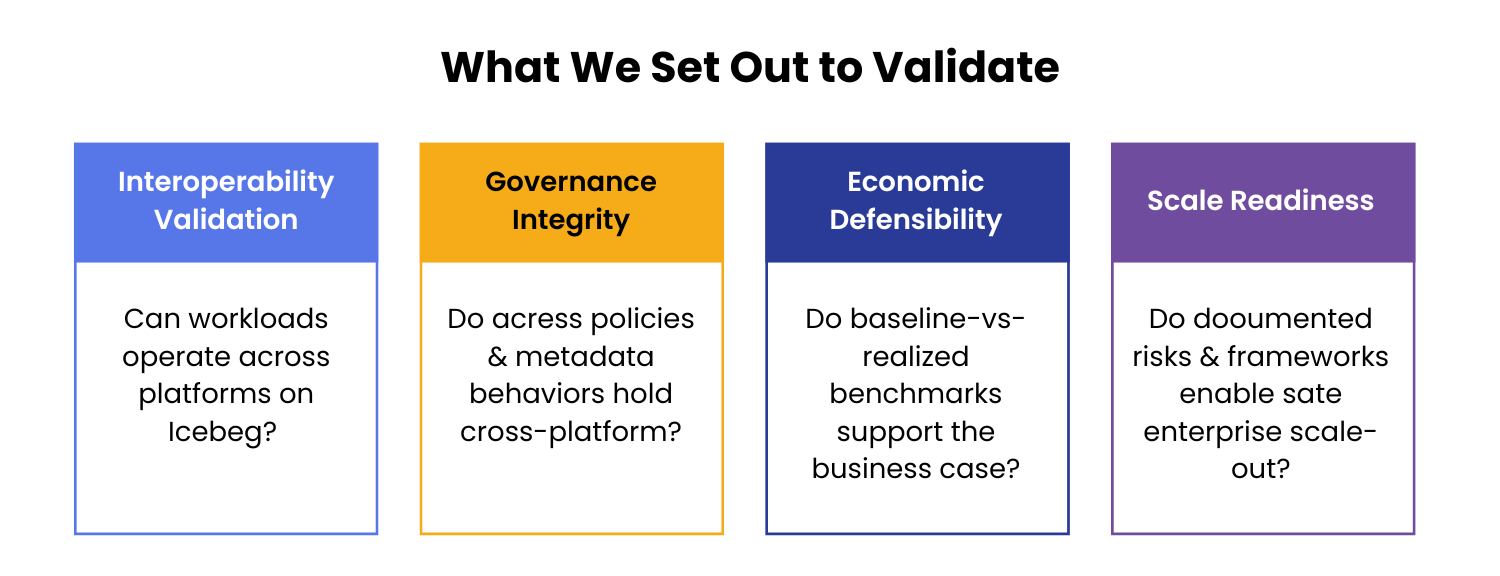
The four dimensions we had to prove

This POC was not designed to confirm that Databricks and Snowflake can exchange data – modern platforms can. It was designed to answer a harder question: Can they operate together on Iceberg without introducing governance or cost complexity that undermines the business case?

That question required evidence across four dimensions:

This framing matters because interoperability only creates enterprise value when all four hold simultaneously. Connectivity without governance discipline creates risk. Cost savings without scale readiness are not repeatable. Each dimension reinforces the others.

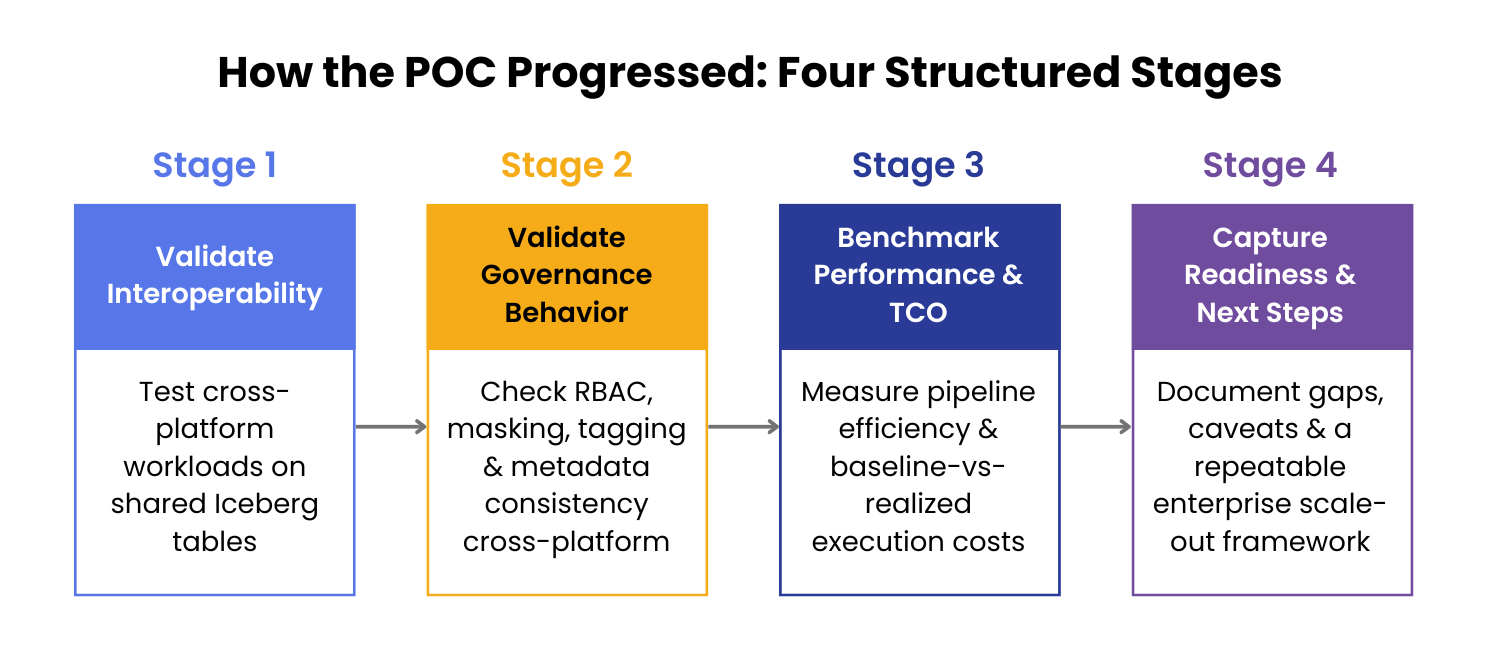
POC execution: A four-stage approach

To keep the evaluation rigorous and decision-relevant, the POC was structured in four sequential stages, each designed to answer a different layer of the interoperability question:

This structure shifted the central question from ‘can the platforms connect?’ to ‘can they operate together sustainably?’, a meaningfully different bar for enterprise readiness.

Architecture: What we evaluated and why

The POC kept the architecture context high-level, focused on the layers that drive leadership decisions:

Layer What was evaluated Why it matters Tool/platform Outcome scope
Compute & analytics Cross-platform workload execution Confirms multi-platform viability Databricks + Snowflake Interoperability
Open table format Shared read/write on Iceberg tables Anchors open-architecture goals Apache Iceberg Interoperability
Governance & catalog Access control under shared patterns Tests policy behavior at the boundary Unity Catalog + Snowflake RBAC Governance
Governance orchestration Policy drift & enforcement risk Addresses orchestration complexity Collibra POV Governance
Cost benchmarking Baseline vs. realized TCO (Total cost of ownership) Ties economics to measurable evidence TCO model Economic

Measuring interoperability: A rubric-based framework

Most interoperability evaluations fail because they rely on subjective assessments, ‘the integration worked’ quickly becomes ‘the architecture is enterprise ready.’ This POC avoided that by applying a structured rubric that evaluates governance behavior, operational performance, and economic outcomes simultaneously.

Each KPI was scored on a 1-5 scale (5 = strongest outcome). Scores were aggregated within categories and weighted by strategic priority, reflecting the reality that governance and interoperability are the dominant risk vectors in multi-platform adoption:

The highest-weighted categories – Data Governance (35%) and Interoperability (35%), both scored at or above 90%, confirming that the architecture can sustain shared access patterns without systematic policy degradation. The remaining 30% weight across pipeline efficiency, cost, and compute all came in at full or near-full marks.

Why this matters: An architecture is not enterprise-ready if governance and interoperability cannot remain consistent over time. The rubric makes that standard explicit and measurable.

TCO findings: Baseline vs. realized compute costs

Most cost comparisons stop at a single number – before versus after. Our TCO analysis took a different approach. Across six use cases evaluated during the POC, we measured execution costs at three levels simultaneously: total cost per use case, cost per GB processed, and cost per pipeline duration. This multi-dimensional view doesn’t just confirm whether migration saves money, it pinpoints where the savings come from and surfaces optimization opportunities that a top-line comparison would completely miss.

Four of the six use cases reached full cost analysis. The results were striking migrating from the current architecture to an interoperable Databricks architecture delivered cost reductions ranging from 65% at the low end to 93% at the high end, not marginal efficiency gains, but a fundamental shift in the economics of each pipeline.

The three-lens measurement model proved particularly valuable here. A use case might show modest total cost savings but dramatic improvement in cost per GB – a signal that it will scale far more economically as data volumes grow. Another might reveal an outsized cost-per-pipeline-duration figure, pointing to a specific transformation stage worth optimizing before full rollout. These are the insights that a simple baseline-versus-realized comparison leaves on the table.

The POC didn’t just validate that the migration pencils out. It produced a cost fingerprint for each use case that teams can carry forward into production planning.

A few observations worth calling out:

  • One use case carried the largest absolute cost baseline yet achieved a 66% reduction. Despite high volume and pipeline complexity, the cost per GB and cost per pipeline duration stayed well within range – a clear signal that the architecture was doing justice to the data it handled. The savings in raw dollars were the highest across all workloads.
  • Another use case delivered the highest percentage improvement at 93%, driven by workload consolidation and Iceberg-native optimizations. This use case made noticeable cost impact with Databricks serverless compute, stating compute understanding and its right fitment plays a key role in cost.
  • The most surprising result? A workload that was already low-cost. At roughly $2 to begin with, it still dropped to $0.25, an 85% improvement. This one breaks the assumption that optimization only pays off at scale. Multiple smaller, targeted improvements stacked up to create a meaningful cost impact, proving that no workload is too lean to optimize.

The key point is not a claim of universal savings. It is a methodological one: these results were produced from baseline-versus-realized evidence tied to real executions, not projections. That is the standard leaders should demand before approving multi-platform investments.

Critical findings: What enterprises must plan for

The most durable outcomes from this POC were not the validation scores – they were the operational truths that only become visible during execution. Each finding below has a direct architectural implication.

1. Access controls do not propagate automatically across platform boundaries.

RBAC, data masking, and tagging policies do not automatically synchronize between Unity Catalog and Snowflake RBAC. This is not a gap that can be patched after deployment – it must be designed for in the governance architecture before rollout. Multi-platform without synchronized enforcement creates compounding risk at scale.

2. Metadata and tagging behavior require explicit orchestration.

Tagging limitations tied to catalog-linked database behavior can restrict native classification capabilities in certain access patterns. Seeing the data is not the same as consistently governing it. Any metadata strategy that assumes automatic propagation will drift – the question is whether you detect it early or after an audit.

3. Operational coordination overhead is structural, not incidental.

As schemas, roles, and data products evolve across platforms, coordination costs are ongoing. When interoperability works technically, ownership becomes shared by default. Without explicit accountability structures, platforms that were meant to complement each other create fragmentation instead.

4. Snowflake write-back to Iceberg requires staged re-validation as the feature matures.

The Snowflake write-back capability demonstrated directional viability but requires continued testing as the feature set evolves. The POC established a repeatable re-testing framework for this specifically. Risk management here is not a one-time gate, it is a scheduled activity tied to platform release cadence.

Bottom line: The POC does not eliminate risk. It gives you a precise, evidence-based map of where the risk lives and what governance structures must be in place before you scale.

Executive action plan: Four strategic moves

For organizations moving from POC to enterprise rollout, these four moves determine whether interoperability becomes a competitive advantage or a governance liability:

1. Treat governance as a control-plane problem, not a configuration task.

Policy synchronization between Unity Catalog and Snowflake RBAC will not happen automatically. Design an explicit drift-management layer either through Collibra orchestration or a comparable policy enforcement mechanism before the first production workload crosses platforms.

2. Formalize accountability before you scale access patterns.

Coordination overhead was explicitly documented across the POC. Ownership of shared Iceberg tables, schema evolution rights, and cross-platform lineage must be assigned in writing not assumed to follow existing organizational structures.

3. Complete structured scale testing before enterprise rollout.

Scale testing should cover a minimum of three concurrent workload patterns across both platforms including at least one high-volume ingestion scenario, one cross-platform transformation, and one governance-sensitive query pattern before sign-off on enterprise deployment. Validate Snowflake write-back behavior under concurrent load as part of this gate.

4. Institutionalize cost visibility as a recurring discipline.

Baseline-versus-realized benchmarking is only valuable if it continues post-deployment. Establish a quarterly TCO review cadence tied to actual platform execution costs not projected savings so the business case remains defensible as workload patterns evolve.

Conclusion

The POC delivered three concrete outcomes: governance and interoperability both scored above 90% under a rubric-weighted evaluation; compute costs decreased between 66% and 93% across all six tested use cases; and four structural operating-model requirements were documented that must be addressed before enterprise-scale deployment.

These results confirm that Databricks and Snowflake can operate together on Iceberg without systematic governance degradation provided that access-control synchronization, metadata orchestration, accountability structures, and cost visibility are explicitly designed rather than assumed.

The organizations that succeed with interoperable architectures are not the ones with the most platforms. They are the ones that treat interoperability as an operating model to be measured and hold their architecture to a baseline-versus-realized standard before they scale.

WIT Leader

Priyanka Sharma

Databricks COE Lead, Wavicle Data Solutions

Priyanka leads the Databricks Center of Excellence at Wavicle, driving innovation, accelerating growth, and enabling high-impact delivery across the organization.

View all my Posts

Related Posts

  • Blog
  • Automated BI Migration
  • Conversational Analytics

Automated BI Migration: Moving Tableau and Powe...

  • 24 Apr 2026
  • 10 min read
  • Blog
  • Automated ETL Migration
  • AWS Glue

ETL Migration Cost Optimization: Legacy ETL to ...

  • 24 Apr 2026
  • 10 min read
  • Blog
  • Advanced Analytics
  • Healthcare

Computer Vision for Health: Living Longer

  • 07 Jul 2025
  • 16 min read
  • 30 May 2025
  • 18 min read
  • Blog
  • Amazon Quicksight
  • BI Reporting & Visualizations

5 Major Benefits of Amazon Quick Suite That you...

  • 28 May 2025
  • 3 min read
  • Blog
  • Amazon Quicksight
  • BI Reporting & Visualizations

Tips and Tricks to Get the Most Out of Amazon Q...

  • 07 May 2025
  • 4 min read
  • 05 May 2025
  • 3 min read
  • 02 May 2025
  • 4 min read
  • Blog
  • Environmental Social & Governance (ESG)

Leveraging AI to Optimize Energy Consumption of...

  • 30 Apr 2025
  • 18 min read
  • Blog
  • Advanced Analytics
  • Predictive Modeling

Predicting the Unpredictable: Leveraging AI to ...

  • 11 Apr 2025
  • 3 min read
  • 28 Mar 2025
  • 2 min read
  • 28 Mar 2025
  • 16 min read
  • Blog
  • Advanced Analytics
  • Retail

Navigating Ethical Issues of AI in Retail

  • 12 Mar 2025
  • 4 min read
  • Blog
  • Advanced Analytics
  • Generative AI & LLM

How Generative AI is Transforming Retail Custom...

  • 12 Mar 2025
  • 5 min read
  • Blog
  • Advanced Analytics
  • Generative AI & LLM

How Text Analytics and Generative AI Are Unlock...

  • 09 Jan 2025
  • 5 min read
  • Blog
  • BI Reporting & Visualizations
  • Business Intelligence & Insights

Transforming BI Reporting and Visualization Wit...

  • 06 Jan 2025
  • 5 min read
  • Blog
  • Cloud Infrastructure Modernization
  • Platform Management

Mastering Cloud Cost Optimization for a More Ef...

  • 03 Jan 2025
  • 5 min read
  • Blog
  • Advanced Analytics
  • Generative AI & LLM

How Generative AI is Transforming the Retail Ex...

  • 20 Dec 2024
  • 21 min read
  • 19 Dec 2024
  • 10 min read
  • 12 Dec 2024
  • 18 min read
  • Blog
  • Business Intelligence & Insights
  • Reporting Modernization

How EZConvertBI Simplifies Your Looker Migration

  • 12 Dec 2024
  • 4 min read
  • Blog
  • Advanced Analytics
  • Business Intelligence & Insights

Transforming Business Intelligence with Looker

  • 12 Dec 2024
  • 6 min read
  • Blog
  • Advanced Analytics
  • Data Governance

Key Challenges in AI Adoption for Businesses

  • 11 Dec 2024
  • 13 min read
  • Blog
  • Advanced Analytics
  • Generative AI & LLM

What AI Disruption Means for Businesses

  • 05 Dec 2024
  • 15 min read
  • Blog
  • Advanced Analytics
  • Business Intelligence & Insights

Optimizing Your Cloud Data Platform with Google...

  • 04 Dec 2024
  • 7 min read
  • Blog
  • Advanced Analytics
  • Amazon Quicksight

From Shopfloor to Boardroom: Get Your Data to T...

  • 21 Nov 2024
  • 5 min read
  • Blog
  • BI Reporting & Visualizations
  • Build & Migrations

Let Your Data Speak to You – Unlocking Organiza...

  • 12 Nov 2024
  • 5 min read
  • Blog
  • Advanced Analytics
  • Business Analytics

The Joy of Decision-Making and Why It Matters

  • 12 Nov 2024
  • 5 min read
  • Blog
  • Data Management
  • Strategy & Assessments

Understanding Data Products

  • 11 Nov 2024
  • 4 min read
  • Blog
  • Advanced Analytics
  • Generative AI & LLM

Crafting User-Focused Solutions and Building an...

  • 06 Nov 2024
  • 12 min read
  • Blog
  • Architecture & Engineering
  • Cloud Infrastructure Modernization

How Data Mesh is Shaping the Future of Data Man...

  • 05 Nov 2024
  • 8 min read
  • Blog
  • Business Intelligence & Insights
  • Reporting Modernization

Streamline your Power BI Migration with EZConve...

  • 22 Oct 2024
  • 4 min read
  • 15 Oct 2024
  • 18 min read
  • Blog
  • Advanced Analytics
  • BI Reporting & Visualizations

How Gen AI and Microsoft Copilot are Reshaping ...

  • 03 Oct 2024
  • 5 min read
  • Blog
  • Advanced Analytics
  • Build & Migrations

Transforming Data Capabilities by Moving Beyond...

  • 25 Sep 2024
  • 5 min read
  • Blog
  • Business Analytics
  • Business Intelligence & Insights

How to Build a Restaurant Performance Measureme...

  • 24 Sep 2024
  • 6 min read
  • Blog
  • Advanced Analytics
  • Business Analytics

Leveraging Data Science and AI to Drive Innovat...

  • 16 Sep 2024
  • 16 min read
  • Blog
  • Advanced Analytics
  • Generative AI & LLM

The Role of Mature Data and AI in Accurate Gene...

  • 26 Aug 2024
  • 14 min read
  • Blog
  • Advanced Analytics
  • Business Analytics

Listening to the Voice of the Customer: A Key t...

  • 21 Aug 2024
  • 6 min read
  • Blog
  • Azure
  • BI Reporting & Visualizations

Moving from Tableau to Power BI: Why Companies ...

  • 20 Aug 2024
  • 6 min read
  • 14 Aug 2024
  • 18 min read
  • Blog
  • Advanced Analytics
  • Demand Forecasting

How to Use Demand Forecasting to Improve Busine...

  • 12 Aug 2024
  • 6 min read
  • Blog
  • Business Intelligence & Insights
  • Cloud Infrastructure Modernization

Building a Data Platform on Snowflake

  • 01 Aug 2024
  • 5 min read
  • Blog
  • Advanced Analytics
  • Demand Forecasting

Why Your Demand Forecasting Model Doesn’t Work ...

  • 30 Jul 2024
  • 7 min read
  • Blog
  • Advanced Analytics
  • Data Governance

Expert Insights on Demonstrating the Value of D...

  • 22 Jul 2024
  • 9 min read
  • Blog
  • Advanced Analytics
  • Generative AI & LLM

How to Effectively Harness Gen AI for Your Busi...

  • 18 Jul 2024
  • 5 min read
  • Blog
  • Advanced Analytics
  • Generative AI & LLM

Navigating the AI Hype Cycle by Setting Realist...

  • 11 Jul 2024
  • 15 min read
  • Blog
  • Advanced Analytics
  • Data Management

Leveraging AI Technology in Healthcare

  • 10 Jul 2024
  • 17 min read
  • Blog
  • Advanced Analytics
  • Data Governance

Expert Insights on Leveraging Data Quality and ...

  • 01 Jul 2024
  • 8 min read
  • Blog
  • Data Governance
  • Privacy Governance & Compliance

Choosing the Right Data Governance Approach for...

  • 24 Jun 2024
  • 5 min read
  • Blog
  • Data Governance
  • Privacy Governance & Compliance

Expert Insights on Leveraging Data Governance f...

  • 11 Jun 2024
  • 12 min read
  • Blog
  • Data Governance
  • Data Management

The Role of Existing Data Stewards in Driving G...

  • 10 Jun 2024
  • 3 min read
  • Blog
  • Data Governance
  • Data Management

Optimizing Data Governance Programs Beyond Chec...

  • 03 Jun 2024
  • 4 min read
  • Blog
  • Data Governance
  • Privacy Governance & Compliance

Measuring Data Governance Progress With Metrics...

  • 29 May 2024
  • 4 min read
  • Blog
  • Data Governance
  • Data Management

Decoding Data Governance: Going Beyond its Name

  • 22 May 2024
  • 5 min read
  • Blog
  • Business Analytics
  • Business Intelligence & Insights

How Your Data Governance Strategy Supports Data...

  • 15 May 2024
  • 4 min read
  • Blog
  • Data Governance
  • Privacy Governance & Compliance

The Need for Data Governance in a Changing World

  • 13 May 2024
  • 4 min read
  • Blog
  • Advanced Analytics
  • Data Management

Crafting a Data Strategy to Support AI in Healt...

  • 30 Apr 2024
  • 13 min read
  • Blog
  • Data Management
  • Data Privacy & Regulatory Compliance

How to Achieve Compliance Excellence in Healthc...

  • 24 Apr 2024
  • 5 min read
  • Blog
  • Environmental Social & Governance (ESG)
  • Manufacturing

Modernizing Supply Chains for Resilience and Su...

  • 17 Apr 2024
  • 8 min read
  • Blog
  • Advanced Analytics
  • Business Analytics

Getting the Absolute Best Data Science Talent t...

  • 16 Apr 2024
  • 14 min read
  • Blog
  • Architecture & Engineering
  • Data Management

How to Design a Modern Data Architecture

  • 10 Apr 2024
  • 5 min read
  • Blog
  • Advanced Analytics
  • Predictive Modeling

How to Re-imagine Customer Experience With Pred...

  • 10 Apr 2024
  • 4 min read
  • Blog
  • Advanced Analytics
  • Generative AI & LLM

Expert Insights on Transformative AI Strategies...

  • 10 Apr 2024
  • 13 min read
  • Blog
  • Data Management
  • Strategy & Assessments

Why Your Organization Needs a Data Strategy

  • 01 Apr 2024
  • 4 min read
  • Blog
  • Data Management
  • Strategy & Assessments

Getting Started With Data Strategy: The AI-Led ...

  • 28 Mar 2024
  • 3 min read
  • Blog
  • Cloud Infrastructure Modernization
  • Cloud Security & Monitoring

The Role of AI and ML in Cloud Security Monitoring

  • 21 Mar 2024
  • 4 min read
  • Blog
  • Data Management
  • Strategy & Assessments

Getting Started With Data Strategy: The Acceler...

  • 20 Mar 2024
  • 4 min read
  • 15 Mar 2024
  • 13 min read
  • Blog
  • Data Management
  • Strategy & Assessments

Getting Started With Data Strategy: The Traditi...

  • 13 Mar 2024
  • 4 min read
  • Blog
  • Healthcare
  • Strategy & Assessments

How Building a Strong Data Strategy Boosts Heal...

  • 12 Mar 2024
  • 7 min read
  • Blog
  • Data Management
  • Strategy & Assessments

The Do’s and Don’ts of Data Strategy

  • 06 Mar 2024
  • 6 min read
  • Blog
  • Advanced Analytics
  • Manufacturing

The Role of Advanced Analytics and AI in Reduci...

  • 04 Mar 2024
  • 5 min read
  • Blog
  • Advanced Analytics
  • Data Management

Reducing Barriers to Complex Data Science Entry...

  • 15 Feb 2024
  • 14 min read
  • 29 Jan 2024
  • 1 min read
  • Blog
  • Advanced Analytics
  • Manufacturing

Manufacturing in 2024: Key Data and Analytics T...

  • 12 Dec 2023
  • 8 min read
  • Blog
  • Advanced Analytics
  • Business Analytics

Data-Driven Dining: Three Essential Data, Analy...

  • 20 Nov 2023
  • 7 min read
  • Blog
  • Advanced Analytics
  • Business Analytics

Demystifying Data and Analytics

  • 24 Oct 2023
  • 12 min read
  • Blog
  • Advanced Analytics
  • Predictive Modeling

Revolutionizing Your Customer Experience Measur...

  • 04 Oct 2023
  • 10 min read
  • Blog
  • Business Analytics
  • Business Intelligence & Insights

How Integrating Reservation and POS Data Can Pr...

  • 27 Sep 2023
  • 4 min read
  • Blog
  • Advanced Analytics
  • Business Intelligence & Insights

Next-Generation CDOs: A Conversation About the ...

  • 25 Sep 2023
  • 12 min read
  • Blog
  • Business Intelligence & Insights

Why Data Analytics Projects Fail and How to Ove...

  • 22 Sep 2023
  • 5 min read
  • Blog
  • Advanced Analytics
  • Machine Learning & MLOps

How to Build Resilient Business Strategies Usin...

  • 22 Aug 2023
  • 6 min read
  • Blog
  • Business Analytics
  • Manufacturing

3 Ways Data Analytics Can Transform Your Supply...

  • 01 Aug 2023
  • 4 min read
  • Blog
  • Business Analytics
  • Manufacturing

How is Data Analytics Transforming Production?

  • 26 Jul 2023
  • 5 min read
  • Blog
  • Advanced Analytics
  • Predictive Modeling

5 Blockers to Effective Artificial Intelligence...

  • 24 Jul 2023
  • 6 min read
  • Blog
  • Data Governance
  • Data Management

Instilling Data Quality Into Your Data Manageme...

  • 20 Jul 2023
  • 7 min read
  • Blog
  • Advanced Analytics
  • Business Analytics

3 Ways Engineers Can Drive Business Value with ...

  • 18 Jul 2023
  • 4 min read
  • Blog
  • Advanced Analytics
  • Predictive Modeling

Calculating ROI for Advanced Analytics Initiatives

  • 15 Jul 2023
  • 6 min read
  • Blog
  • Data Management
  • Strategy & Assessments

How Business Leaders Leverage Data as a Critica...

  • 15 Jun 2023
  • 7 min read
  • Blog
  • Amazon Quicksight
  • BI Reporting & Visualizations

Clear and Actionable: Wavicle’s Winning Dashboard

  • 09 May 2023
  • 2 min read
  • Blog
  • Cloud Infrastructure Modernization
  • Platform Management

The Importance of Effective Cloud Platform Mana...

  • 07 May 2023
  • 4 min read
  • Blog
  • Architecture & Engineering
  • Data Management

Data Architecture 101: Trends and Terms to Know

  • 25 Apr 2023
  • 6 min read
  • Blog
  • Build & Migrations
  • Data Management

Which Data Storage Solution is Right for Your O...

  • 04 Apr 2023
  • 6 min read
  • Blog
  • ActiveInsights
  • Advanced Analytics

The Future of Voice of Customer: 5 Trends to Watch

  • 18 Jan 2023
  • 8 min read
  • Blog
  • Data Governance
  • Data Privacy & Regulatory Compliance

Why a Good Governance, Privacy, and Compliance ...

  • 08 Nov 2022
  • 7 min read
  • 22 Sep 2022
  • 3 min read
  • Blog
  • Advanced Analytics
  • Machine Learning & MLOps

Five Steps To Operationalizing Advanced Analyti...

  • 24 Nov 2021
  • 5 min read
  • Blog
  • Augment
  • Data Privacy & Regulatory Compliance

A New Way to Quickly and Easily Discover PII Da...

  • 19 Oct 2021
  • 2 min read
  • Blog
  • Architecture & Engineering
  • Augment

6 Reasons You Need an Augmented Data Quality So...

  • 16 Sep 2021
  • 5 min read
  • Blog
  • ActiveInsights
  • Business Analytics

Ditch the Survey and Really Get to Know Your Cu...

  • 15 Jul 2021
  • 8 min read
  • Blog
  • Architecture & Engineering
  • Business Analytics

Five Reasons Why Boutique Consulting Firms Are ...

  • 21 Jun 2021
  • 6 min read
  • Blog
  • Advanced Analytics
  • Machine Learning & MLOps

Deep Multi-Input Models Transfer Learning For I...

  • 14 Jun 2021
  • 15 min read
  • Blog
  • Advanced Analytics
  • Machine Learning & MLOps

Deep Learning For Natural Language Processing o...

  • 08 Jun 2021
  • 9 min read
  • Blog
  • ActiveInsights
  • Customer 360

5 Ways to Successfully Win Travelers’ Loy...

  • 25 May 2021
  • 6 min read
  • Blog
  • Business Analytics
  • Business Intelligence & Insights

Want to Meet Consumer Expectations? Demand Fore...

  • 25 May 2021
  • 9 min read

  • Blog
  • Advanced Analytics
  • Customer 360

These 3 Top Retail Analytics Trends are Revolut...

  • 25 May 2021
  • 7 min read
  • 27 Apr 2021
  • 5 min read
  • Blog
  • Architecture & Engineering
  • Business Analytics

8 CDOs Share Key Insights on How to Build a Suc...

  • 23 Apr 2021
  • 6 min read
  • Blog
  • Business Analytics
  • Business Intelligence & Insights

Here’s Why 2021 is Actually the First “Year of ...

  • 07 Apr 2021
  • 10 min read
  • Blog
  • Advanced Analytics
  • Business Analytics

Five Critical Elements For Successful Customer ...

  • 17 Feb 2021
  • 5 min read
  • Blog
  • Architecture & Engineering
  • Business Analytics

Everything You Need to Know About Data & A...

  • 15 Jan 2021
  • 5 min read
  • Blog
  • Business Intelligence & Insights
  • Data Management

What Happens When Insurers Turn to Data Analytics?

  • 04 Jan 2021
  • 4 min read
  • Blog
  • Architecture & Engineering
  • Data Management

What Happens When ERP Systems Talk? The Results...

  • 04 Jan 2021
  • 5 min read
  • Blog
  • Data Management
  • Data Privacy & Regulatory Compliance

Compliance Data Management: the Case For Automa...

  • 02 Dec 2020
  • 5 min read
  • Blog
  • Architecture & Engineering
  • Data Management

Compliance Data Management: Data Preparation Sa...

  • 02 Dec 2020
  • 7 min read
  • Blog
  • Business Analytics
  • Customer 360

Your Customers Like You, They Really, Really Li...

  • 25 Aug 2020
  • 9 min read
  • Blog
  • Predictive Modeling
  • Restaurant

Why Micro-Segmentation Matters in a Post-COVID ...

  • 10 Aug 2020
  • 6 min read
  • Blog
  • Architecture & Engineering
  • Data Management

Data Architecture From Right to Left: Start Wit...

  • 18 May 2020
  • 6 min read
  • Blog
  • Business Analytics
  • Business Intelligence & Insights

Using Big Data to Better Predict Your Recovery:...

  • 11 May 2020
  • 8 min read
  • Blog
  • ActiveDeliver
  • ActiveInsights

Mamma Mia!

  • 20 Feb 2020
  • 6 min read
  • Blog
  • Cloud Infrastructure Modernization
  • Data Management

How to Get Faster, More Reliable Analytics from...

  • 04 Dec 2019
  • 7 min read
  • Blog
  • ActiveInsights
  • Architecture & Engineering

Take Ownership of the Relationship with Your Di...

  • 04 Dec 2019
  • 4 min read
  • Blog
  • ActiveDeliver
  • Business Intelligence & Insights

Food Delivery: Who Owns the Customer?

  • 05 Nov 2019
  • 5 min read
  • Blog
  • Business Analytics
  • Business Intelligence & Insights

Quick Service Restaurants are Ravenous for Big ...

  • 03 Apr 2019
  • 4 min read
  • Blog
  • Architecture & Engineering
  • Data Management

CDO Summit Key Takeaways

  • 02 Apr 2019
  • 7 min read
  • Blog
  • Advanced Analytics
  • BI Reporting & Visualizations

2019 Business Intelligence Trends

  • 16 Oct 2018
  • 3 min read
  • 29 Mar 2018
  • 3 min read