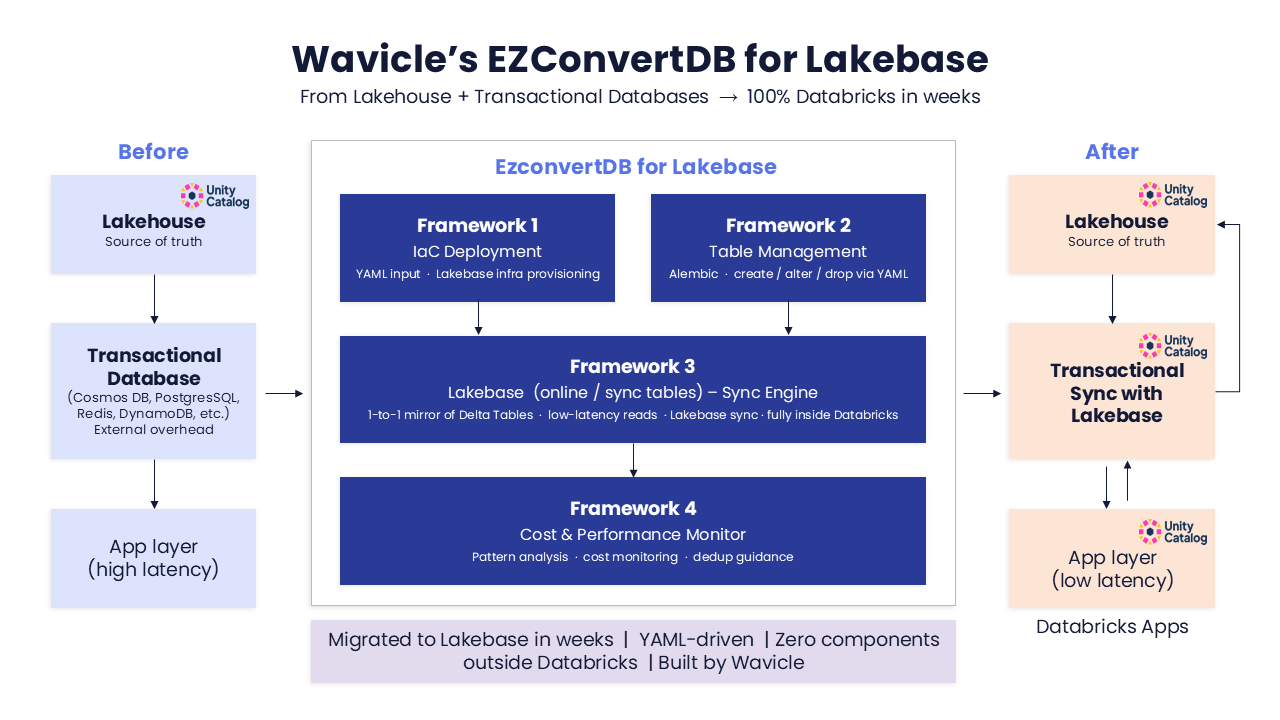
How Wavicle’s EZConvertDB for Lakebase integrates two data worlds into one, in weeks, on a single Databricks platform.
Many established data organizations face a common challenge: despite having robust lakehouse architectures and strong analytics, real-time AI applications are hampered by external transactional databases. Databases like Cosmos DB, PostgreSQL, Redis, and DynamoDB were designed for quick and reliable data operations, but over time, they have evolved into separate sources of truth and governance. This separation creates maintenance burdens and fragile ETL pipelines, making it difficult for business users to access timely analytics and AI solutions—not due to technology limitations, but because the architectural setup restricts fast data movement.
The hidden cost of running two systems
Many organizations underestimate the financial and engineering costs involved in maintaining separate transactional databases and Lakehouses. Beyond direct expenses like compute, storage, and licensing, indirect costs include duplicated governance, fragile data pipelines, and challenges for business users and data scientists accessing timely, live data. This ongoing complexity leads to confusion about which system serves as the true source of data.
A unified path forward: Databricks Lakebase
Databricks Lakebase eliminates the need for a separate transactional database by allowing fast, transactional reads within the Databricks platform. This creates a single source of truth, unifying governance, storage, and operations. While the concept is clear, organizations with long-standing investments in external transactional systems must carefully plan their transition to achieve this unified architecture.
Wavicle’s EZConvertDB for Lakebase: Built for the migration, not just the destination
Wavicle’s EZConvertDB for Lakebase is designed to help organizations transition from external transactional databases to a unified Lakebase architecture within Databricks. The solution combines consulting with an accelerator and is organized around four core frameworks, addressing infrastructure setup, data migration, and operational continuity, enabling the migration process to be completed in a matter of weeks.
We explain the purpose and significance of each framework below.
Framework 1: Infrastructure-as-code deployment
Framework 1 of Wavicle’s EZConvertDB for Lakebase simplifies infrastructure setup by using YAML-driven Infrastructure-as-Code (IaC) deployment. Teams can describe their desired Lakebase environment in configuration files, allowing the accelerator to provision the environment without needing specialized platform expertise. This approach ensures repeatable and auditable deployments. By codifying infrastructure provisioning and version control, it removes common delays and bottlenecks often encountered during migration projects.
Framework 2: Table lifecycle management via Alembic
Schema management often poses challenges during database migrations, leading to discrepancies between migration scripts and actual database states. EZConvertDB for Lakebase addresses this issue by utilizing Alembic, a robust Python-based schema migration tool. Through YAML-driven configuration, all table lifecycle operations, creation, modification, and deletion, are tracked, versioned, and reversible. This approach provides organizations with confidence to adapt their data models as their business evolves, minimizing risks associated with schema changes.
Framework 3: LLM-Powered Sync Engine
Wavicle’s LLM-powered Sync Engine, the core of the EZConvertDB for Lakebase accelerator, enables seamless, low-latency synchronization of Delta Tables in Lakebase within Databricks. By automating schema mapping and sync-mode selection using metadata analysis, the Sync Engine replaces manual engineering with intelligent, scalable migration. It also ensures existing security and governance rules are preserved.
This approach makes it practical for enterprises with extensive and complex schemas to migrate at business speed, resulting in a unified, real-time Lakebase environment entirely within Databricks for both application teams and business users.
Framework 4: Cost and performance monitoring
The fourth framework of Wavicle’s EZConvertDB for Lakebase focuses on price-performance monitoring during migration. It provides a layer that tracks consumption and cost across both old and new environments, helping organizations identify redundant data and compare expenses. This evidence-based approach enables teams to confidently retire legacy transactional databases, ensuring there are no lingering systems or unnecessary infrastructure after migration.
Wavicle’s EZConvertDB for Lakebase capabilities
There are three notable capabilities of the EZConvertDB for Lakebase that merit specific attention.
1. YAML-driven throughout. The migration process is defined in configuration files, making it auditable, consistent across environments, and easy to maintain without extensive engineering effort.
2. Zero components outside Databricks. All components, including the sync engine, monitoring layer, and migrated tables, operate natively within Databricks. This eliminates the need for additional integrations, vendor management, or new security concerns.
3. Completion in weeks, not months. The LLM-powered metadata sync engine accelerates schema mapping by automating the process, significantly reducing manual effort and shortening migration timelines.
What changes after the migration
The transition described is primarily architectural but delivers tangible business benefits. Previously, applications queried an external transactional database, resulting in high latency, fragmented governance, and ongoing ETL pipeline maintenance. Analytics lagged behind real-time events.
After migration, applications access Lakebase within Databricks at low latency, unified governance via Unity Catalog eliminates the need for ETL maintenance, and both transactional and analytical processes operate on live data. This enables real-time personalization, customer segmentation, marketing offers, and operations, supporting advanced features like recommendation engines and dynamic customer engagement that were previously difficult to achieve.
The right time to move
In summary, maintaining both a Lakehouse and an external transactional database increases costs and complexity, while hindering real-time insights. Databricks Lakebase, combined with Wavicle’s EZConvertDB for Lakebase, offers a streamlined, low-risk migration path to a unified, modern architecture.
Now is the ideal time to evaluate whether your current setup continues to deliver value. Take action to simplify your environment, reduce overhead, and unlock real-time analytics by making the move to Lakebase with Wavicle’s proven migration solution.


 08 Jun 2026
 5 min read