04 May 2026
 5 min read



Featured on Databricks: Wavicle’s EZConvertBI for AI/BI was recently included in a Databricks blog showcasing innovative AI/BI Genie partner solutions across industries and business functions. The feature highlights Wavicle’s approach to helping organizations transition from traditional BI environments to conversational analytics while maintaining trust in existing metrics and reporting. Click here to read the blog.
Customers today are entering the next phase of analytics adoption.
They increasingly expect conversational experiences, dynamic dashboards, and AI-driven insights to be part of their analytics environment.
At the same time, legacy BI environments are becoming harder to sustain, with rising license costs and shifting vendor priorities, adding pressure to modernize.
The direction is clear. Yet progress often slows before value is realized.
The challenge is not the intent or platform capability. It stems from what is already working. Dashboards in Power BI and Tableau remain deeply embedded in decision-making, and any change that risks KPI consistency or user workflows, introduces uncertainty or retraining, and teams are not willing to take the risk. These issues do more than slow modernization, they erode trust and adoption.
As a result, organizations are caught between the need to modernize and the risk of disrupting what the business already relies on for decision-making.
What a safe transition looks like
Modernization requires a controlled transition that preserves business continuity while enabling new capabilities. A practical approach follows four steps:
1. Establish visibility across the BI landscape
Inventory dashboards, reports, usage patterns, and data dependencies to identify what is actively used and what can be optimized or retired. This approach manages the scope of modernization.
2. Preserve KPI consistency and user workflows
Migrate high-value dashboards without altering metric logic or disrupting how teams interact with data.
3. Introduce AI capabilities alongside existing analytics
Enable conversational analytics and AI-driven insights alongside existing dashboards, reinforcing confidence in AI outputs by grounding them in trusted KPI baselines.
4. Expand toward proactive, AI-driven analytics
Transition from static reporting to automated insights and decision support.
This approach ensures that modernization improves capability without reducing adoption.
Enabling execution with Wavicle’s EZConvertBI for Genie, Analytics Command Center
Once the strategy is defined, customers need to move forward without disrupting trusted dashboards and KPIs. They can do that safely in a structured and governed way using Wavicle’s EZConvertBI for Genie, an Analytics Command Center (ACC).
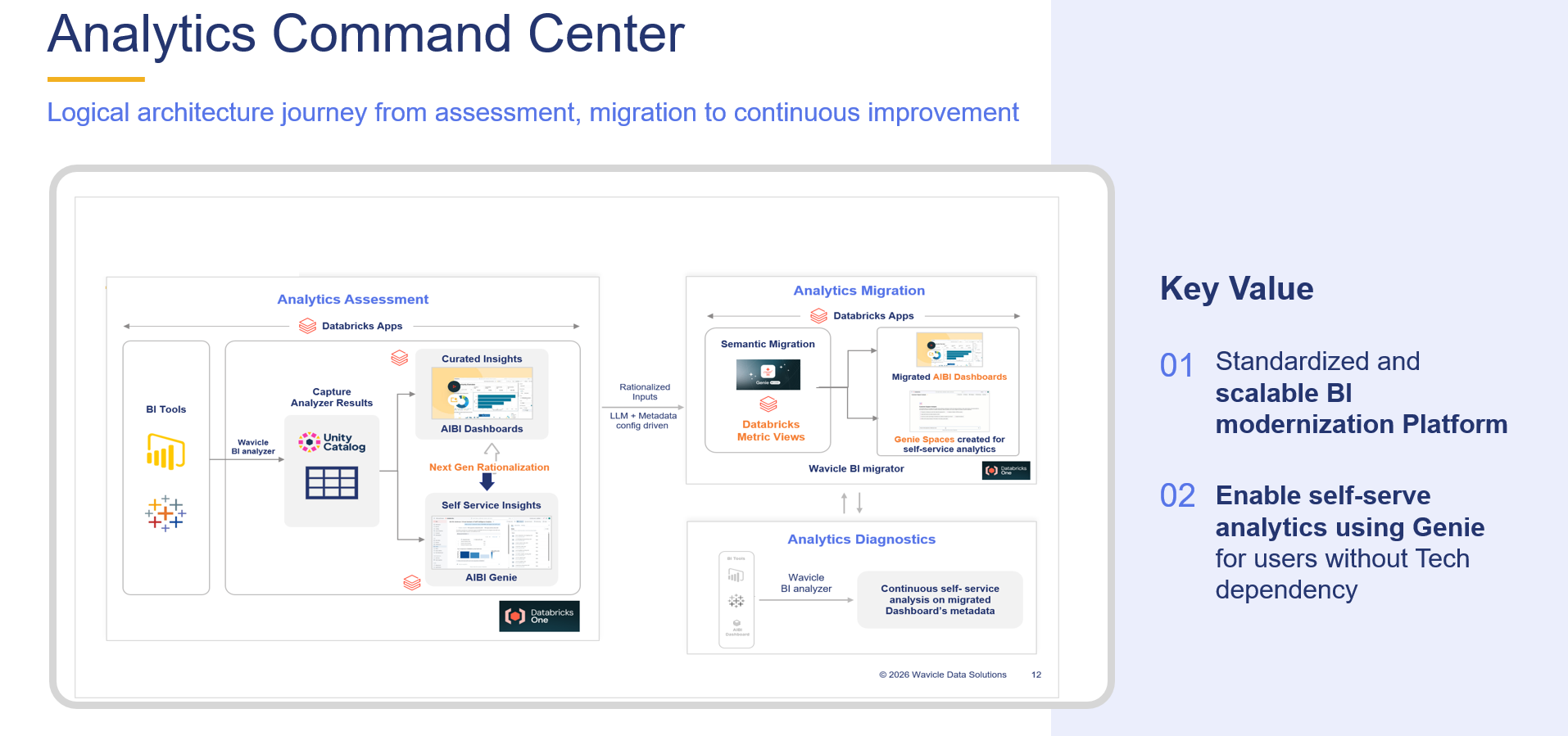
ACC is built on the Databricks Data Intelligence Platform, unifying governed data, analytics, and AI within a single environment. ACC brings together three tightly integrated capabilities to optimize modernization and setting the foundation for conversational analytics:
1. Analytics assessment
ACC analyzes the customer’s current analytics landscape, dashboards, reports, KPIs, data dependencies, and usage patterns, to determine redundancies, duplicate reports, and inefficiencies. This helps identify which artifacts are actively used and which can be optimized or retired, reducing the scope and cost of migration. These curated insights are available in Genie.
2. Continuity-led migration
With this foundation, workloads are either migrated incrementally to Databricks or available for self-service analytics. The governed semantic layer built from the assessment ensures that source and target dashboards remain functional, KPIs stay consistent, self-service capability is functional, and users are not forced into abrupt changes. Modernization happens alongside ongoing operations, not in competition with them.
3. Analytics diagnostics
For ongoing operations, ACC continuously monitors usage, KPI consistency, semantic drift, and data quality. This ensures trust is maintained over time and ACC provides a stable foundation for scaling advanced AI, conversational analytics, and agent-driven capabilities.
Together, these capabilities enable teams to move from fragmented BI environments to a governed, Agentic AI-ready analytics foundation, without disruption.
This structured execution model reduces risk while delivering value. It improves decision velocity, the ability to shift investment from maintaining systems to enabling decisions.
ACC defines the execution model for safe modernization, while Databricks provides the governed platform that enables it at scale.
Databricks as the foundation for a unified transition
A controlled, trust‑preserving modernization approach requires a platform that can unify data, analytics, and AI under consistent governance. This is where Databricks becomes foundational.
With Unity Catalog and Databricks Metric Views, teams can centrally define and govern data and KPIs, and access them across the analytics landscape. This ensures metric definitions remain consistent as systems evolve, eliminating conflicting outputs and preserving trust across teams.
On this governed foundation, Databricks supports multiple ways to perform analysis without fragmenting logic or governance:
- AI/BI Dashboards for trusted, governed reporting
- Databricks AI/BI Genie for natural‑language data access
- Genie Spaces for shared exploration, validation, and collaboration
- Databricks Apps to embed analytics directly into business workflows
Together, these capabilities reduce duplication, improve consistency, and accelerate access to trusted insights.
Databricks also enables a clear progression in analytics consumption:
- Dashboards maintain continuity for existing users
- Conversational analytics improves accessibility
- AI‑driven insights support more proactive decision-making
This progression allows organizations to introduce advanced capabilities incrementally, without disrupting existing workflows or breaking KPI trust.
In this model, Databricks provides a unified, governed, and scalable analytics foundation, supporting modernization while preserving consistency, adoption, and confidence in data.
Optimized modernization with ease
The modernization initiatives on Databricks platform ensure scaling adoption with trust and governance, while reducing costs.
New capabilities are introduced as the systems remain consistent, trusted, and aligned with how customers already work.
A phased, continuity-led approach enables customers to modernize without losing that alignment.
Organizations that succeed are the ones that modernize without breaking trust in their data.
Start your transition to Databricks with confidence
For customers looking to modernize their BI landscape, Wavicle’s EZConvertBI for Genie, an Analytics Command Center, provides a structured starting point. Customers begin with a clear view of their current environment, and define an optimized and low-risk path towards conversational analytics and an agentic experience adopting Genie on Databricks.
Contact us to start a focused assessment of your current BI landscape and define a practical, low-risk path forward.