


A leading financial services organization faced mounting operational pressure from slow, manual contract management processes. Delays in legal approvals were costing business, and late payment recovery was eroding revenue. Partnering with Wavicle Data Solutions, the organization deployed a Document Intelligence AI Chatbot built on Databricks Mosaic AI and Unity Catalog. The result: contract review cycles compressed from days to hours, payment notification lag reduced from months to days, and a reusable Gen AI framework established for future document-intensive workflows across the enterprise.
- Databricks Unity Catalog
Financial Services Firm Transforms Contract Management with AI Document Intelligence



Customer overview
The financial services organization is operating at the intersection of fleet logistics and commercial lending, providing end-to-end vehicle leasing, fleet management, and mobility solutions to businesses spanning multiple industries. Their operations are inherently contract-intensive: each client relationship is governed by a portfolio of legal agreements covering lease terms, early termination rights, indemnity obligations, non-disclosure conditions, and renewal schedules. As the firm scaled, the volume and complexity of these agreements outpaced the capacity of its legal and operations teams to manage them manually, creating a growing backlog of approvals, billing delays, and compliance risk that demanded a fundamentally different approach.
Business challenges
The firm faced three interconnected operational challenges, each compounding the others and collectively threatening both revenue performance and regulatory standing.
Slow legal approval cycles
Decisions on fleet and vehicle leasing transactions routinely took several days to finalize, as legal teams had to manually locate, read, and interpret relevant contract clauses before rendering an opinion. In a competitive market where counterparties expected rapid responses, each day of delay represented not just a process inefficiency but a tangible risk of losing business to faster-moving competitors. The bottleneck was not the judgment of the legal team — it was the time required to surface the right information from a sprawling, unstructured document repository.
Delayed billing and payment recovery
Contract expiration notifications and revised invoices were routinely dispatched weeks or even months behind schedule. The root cause was simple: identifying which contracts were approaching expiration, who needed to be notified, and what revised terms applied required manual cross-referencing across hundreds of agreements. This systemic lag directly impaired cash flow and strained client relationships, undermining the firm’s ability to manage its receivables with the precision a leasing business demands.
Slow contract amendment propagation
When standard contract terms were updated, whether in response to regulatory changes, market conditions, or internal policy shifts, identifying every affected agreement and issuing revised contracts to all relevant counterparties was an exercise that could take months. This extended propagation window left the firm exposed to compliance risk: operating under superseded terms, missing regulatory deadlines, or inadvertently enforcing clauses that had already been legally revised.
Solution
Recognizing the scale of the challenge, Wavicle designed and deployed an advanced Document Intelligence platform built on Retrieval-Augmented Generation (RAG) technology. Rather than replacing legal judgment, the platform augments it, giving every member of the legal, procurement, and fleet operations teams the ability to interrogate the firm’s entire contract portfolio through plain-language conversation, and to receive precise, cited answers in seconds rather than hours.
Natural language contract search and contextual Q&A
At the core of the platform is a conversational interface that allows users to query the full document repository as naturally as they would ask a colleague. A query such as “Show all lease agreements with early termination clauses signed with logistics partners in 2023”, returns not just a list of documents but relevant excerpts, concise summaries, and direct citations, all drawn in real time from across the portfolio. Every AI-generated response includes source traceability and a comprehensive audit trail linking directly to the underlying document text and metadata. This citation-first design is non-negotiable in a regulated financial services environment, where the ability to trace every conclusion back to a specific clause in a specific agreement is a condition of compliance, not a nice-to-have.
Clause-level semantic extraction and smart filtering
The platform automatically identifies and tags key contract provisions, indemnity clauses, non-disclosure terms, termination conditions, renewal triggers, without requiring users to know where in a document those clauses appear. Sophisticated search filters combine AI-powered semantic retrieval with metadata-driven facets, enabling teams to rapidly pinpoint the agreements most relevant to any operational or strategic question. This capability transforms what was previously a days-long manual exercise into a task measured in seconds.
Secure, governed access
Role-based access controls ensure that document visibility and search results are scoped to the user’s function. Legal personnel see the full agreement landscape; procurement teams access vendor-relevant contracts; fleet operations staff are directed to the operational agreements that govern their workflows. This governance model protects commercially sensitive information, satisfies corporate policy requirements, and ensures that the platform can be deployed broadly without creating information-security risk.
Guided query mode
For users who are less familiar with contract terminology or the structure of the repository, a guided query interface prompts clarifying questions, helping users refine their intent and ensuring that the AI’s responses are maximally relevant. This lowers the adoption barrier across the organization and extends the platform’s value beyond the core legal team to business users who need contract intelligence but lack formal legal training.
Technical architecture
The platform is built on an enterprise-grade stack engineered for semantic precision, operational security, and production-scale reliability. The diagram below illustrates the end-to-end data and inference flow, from document ingestion through to user response.
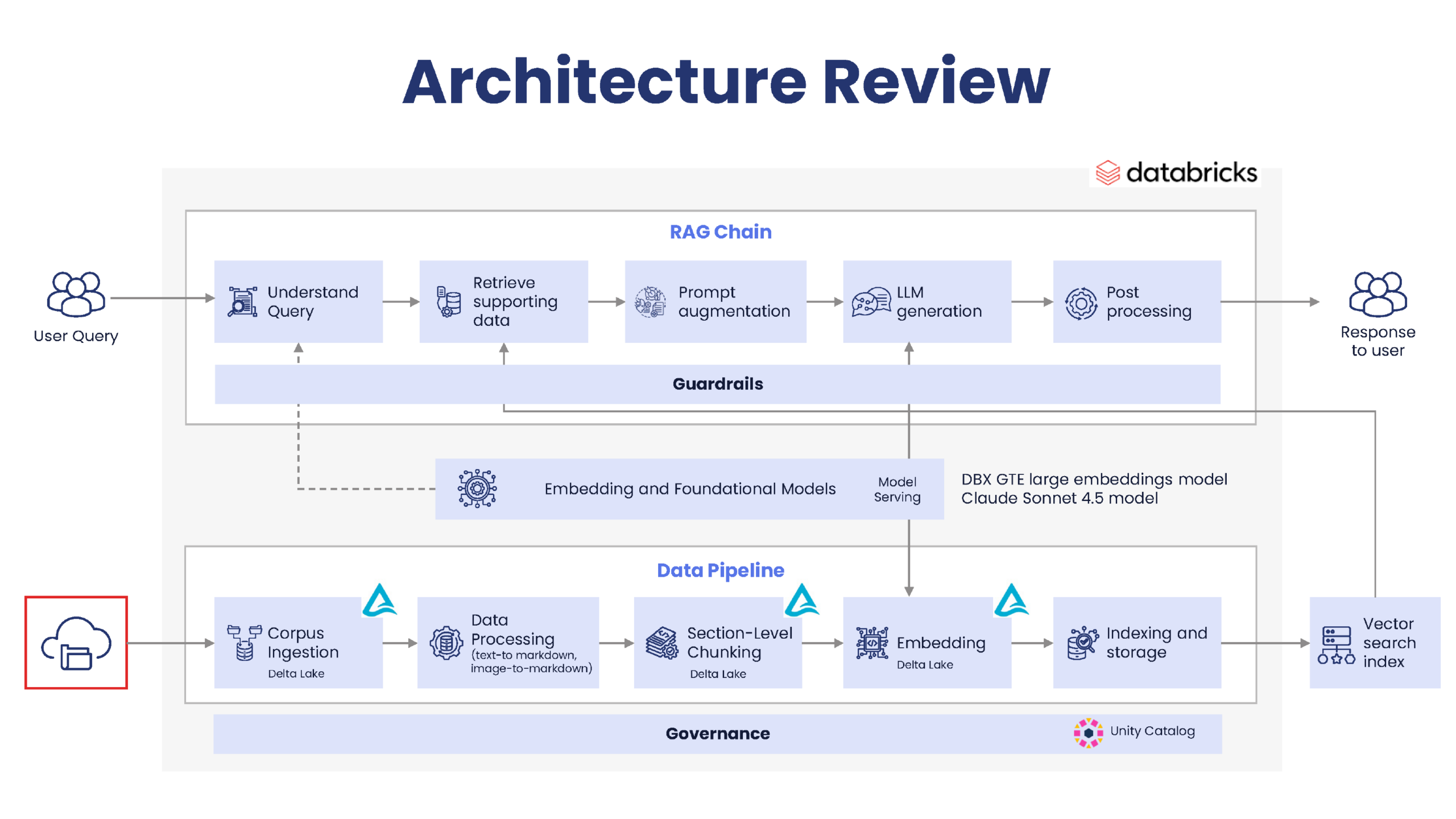
Databricks Unity Catalog serves as the organizational backbone, housing document metadata, segmented document chunks, and vector embeddings tables. The PDF ingestion pipeline processes legal contracts using hierarchical, section-aware chunking, preserving clause boundaries that are critical for accurate semantic retrieval. Vector embeddings are generated via the Databricks Foundation Model API (DBX GTE large embeddings model), and the RAG agent integrates Claude Sonnet 4.5 via Databricks Mosaic AI, returning real-time responses with source citations and confidence scores. A dedicated post-processing layer normalizes formatting, deduplicates content using Jaccard similarity, and re-ranks citations by relevance, keeping every response clean and audit-ready. The entire platform is surfaced through a Next.js web application deployed within Databricks Apps on serverless compute, accessible to non-technical staff across all functions. Automated deployment pipelines and a dedicated SQL warehouse for analytics queries completes the operational foundation.
The Databricks services used in the solution are:
- Databricks Apps: Hosts the Next.js web application on serverless compute, allowing non-technical enterprise users to securely interact with the RAG agent within the corporate data perimeter without external infrastructure.
- Databricks Unity Catalog: Acts as the centralized governance tier managing data access controls, schemas, file locations, document metadata, and line-of-sight auditing for chunks and vector tables.
- Databricks Mosaic AI Model Serving: Dynamically exposes and manages endpoints for both the embedding task (DBX GTE large embeddings model) and the generation task (Claude 4.5 Sonnet via Databricks Foundation Model APIs).
- Delta Lake on Databricks: Used explicitly across the Bronze, Silver, and Gold ingestion layers (Corpus Ingestion, text-to-markdown processing, section-level chunking, and final embedding tables).
- Databricks Vector Search: Operates the target index layer (Vector search index), handling real-time query embedding comparisons and pushing the resulting document references back to the RAG loop.
Business outcomes
The deployment of the Document Intelligence platform delivered measurable, multi-dimensional improvements across the firm’s legal, financial, and operational performance:
Operational efficiency
- Contract review cycles reduced from days to hours, accelerating legal approvals and eliminating the delay-driven loss of business opportunities.
- Automated clause-level search replaces manual contract analysis, significantly reducing legal team workload and freeing attorneys for higher-value work.
- Contract expiration notification lag reduced from months to days, enabling timely billing and faster payment recovery.
Risk mitigation
- Source-cited AI responses reduce the risk of legal error by grounding every conclusion in traceable contract language.
- Rapid identification of all agreements affected by a contract term change reduces the window of compliance exposure from months to days.
- Role-based access controls enforce information governance, reducing the risk of unauthorized access to sensitive agreements.
Revenue impact
- Faster legal approvals directly support faster deal closure in fleet and vehicle leasing, protecting revenue that was previously deferred or lost.
- Timely billing and payment recovery workflows improve cash flow across the fleet management portfolio.
Strategic and competitive advantage
- The RAG-based framework is architecturally reusable, providing a scalable foundation for future document-intensive Gen AI workflows across the enterprise.
- Early adoption of AI-driven legal processes positions the firm as an innovation leader within the fleet leasing and financial services sectors.
- The solution meets enterprise standards for governed, secure LLM deployment, ensuring regulatory compliance as AI usage scales.
Related Posts


- GCP
- Terraform
Global QSR Ensures Uninterrupted Customer Exper...

- BigQuery
- DataFlow
Global QSR Improves Sales with Micro-Segmentation

- Amazon S3
- AWS
Enterprise Databricks Cost Optimization for a G...

- BigQuery
- Databricks
Global QSR Strengthens GCP Migration with Indep...


- Enterprise Data Warehouse
Global QSR Deploys Enterprise-Scale Order Accur...

- Python
- Visual Studio Code
Global QSR Transforms File Recovery Through Pyt...


- Databricks
- Databricks Unity Catalog
Retail Enterprise Advances eCommerce and Loyalt...


- Azure
- Power BI
HVAC Manufacturer Uses EZForecast to Transform ...

- Amazon Quick Suite
- AWS
Structured Power BI to Amazon Quick Sight Migra...

- Microsoft Power BI
- Power BI
Financial Services Company Migrates from Tablea...

- Amazon Aurora
- AWS
Global QSR Standardizes Shift Leadership Verifi...

- Azure
- Business intelligence & insights
From “We Think” to “We Know”: How BGR Found The...

- AWS
- Databricks
Global QSR Saves $1 Million in Cloud Costs in 9...

- AWS
- AWS Inspector
Leading Auto Marketplace Eliminates 2,400+ Vuln...


- Azure
- Copilot
Global Packaging Material Manufacturer Moderniz...

- Amazon Quick Suite
Turbocharging Voice of Customer Analytics Using...

- Databricks
- EZForecast
Empowering Planners with Interactive Forecastin...

- Azure
- Databricks
Global Packaging Material Manufacturer Streamli...

- AWS
- Databricks
Global QSR Chain Strengthens Data Governance by...


- Azure
- Databricks
Healthcare Company Optimizes Cloud Costs in Pre...

- Amazon Quick Suite
- Business intelligence & insights
Seamlessly Migrating 550+ Dashboards from Table...

- Amazon Quick Suite
- AWS
Seamlessly Migrating 550+ Dashboards from Table...

- Amazon Quick Suite
- AWS
Global Digital Platform Migrates from Tableau t...

- Azure
- EZConvertBI
Manufacturer Transforms Forecasting Process Wit...


- Azure
- Microsoft Fabric
Standards Body Centralizes Supply Chain Data to...

- Power BI
- Tableau
U.S. Air Force Leverages Wavicle’s EZConvertBI ...

- MicroStrategy
- SAP Business Objects
International Manufacturer Leverages Wavicle’s ...

- Azure
- Azure ML
Greenhouse Grower Improves Yield Predictions Th...

- Amazon Quick Suite
- Tableau
Rail Technology Services Provider Upgrades Anal...

- Amazon Quick Suite
- Amazon S3
Global Automotive Supplier Modernizes Reporting...


- Microsoft Fabric
- Microsoft SQL Server
Greenhouse Grower Modernizes Data and Insights ...

- Amazon Redshift
- BigQuery
Major Home Builder Leverages Snowflake to Catal...


- Salesforce Net Zero Cloud
- Talend
QSR Improves Sustainability Initiatives With Ac...


- Amazon Athena
- Amazon Quick Suite
International Coffee Chain Modernizes Business ...


- Amazon S3
- AWS
Pilot Company Transforms Data Ecosystem to Unif...

- AWS
- Databricks
Healthcare Product Supplier Launches Feature St...

- Matillion
- Power BI
Merchants Fleet Fuels Growth With Modern Data A...

- Amazon QLDB
- Amazon Redshift
Medical Equipment Manufacturer Saves Millions o...

- Amazon QLDB
- Amazon Redshift
Accelerating Store-Level Speed to Insight for P...

- Amazon Quick Suite
- Amazon S3
Automotive Supplier Leverages Data Modernizatio...


- Amazon Redshift
- Tableau
QSR Maximizes Franchise Performance Using BI Vi...

- Azure
- Profisee
Manufacturer Unlocks Growth With Unified Custom...

- Azure
- Azure ML
Automotive Retailer Modernizes Data Management ...


- AWS Glue
- Snowflake
Global Electronics Manufacturer Saves Millions ...

- Alteryx
- Oracle
Global Manufacturer Overhauls Data Practices wi...


- Amazon Athena
- Amazon Redshift
Accelerated Data Validation With Wavicle’s Data...

- AWS
- Matillion
Major Insurer Transforms Operations With Modern...


- Amazon Quick Suite
Vyaire Medical Gets Global Sales, Inventory, an...

- Amazon Elastic Container Service (ECS)
- AWS Aurora
Travel Center Operator Accelerates Access to Da...

- Amazon S3
- AWS
Travel Center Operator Migrates to Cloud Data W...


- Amazon Redshift
- Amazon S3
New Ordering System Uses Machine Learning to Op...

- Amazon Redshift
- Talend
Global QSR Uses Micro-Segmentation to Improve C...

- Amazon Redshift
- AWS Aurora
Modernizing ESG Data for Resilience and Compliance

- Amazon Redshift
- AWS Aurora
Master Data Management Delivers Single View of ...


- Amazon Redshift
- Amazon S3
Electronics Manufacturer Optimizes Global Logis...

- Amazon Redshift
- Amazon S3
Modernizing ESG Data for Resilience and Compliance

- AWS
- IBM DataStage
Global QSR Accelerates Migration from Legacy ET...

- Amazon Redshift
- Amazon S3
Integrated Procurement Analytics Platform Drive...

- Amazon Redshift
- Amazon S3
Cloud Migration Brings Agility and Innovation t...

- Amazon Redshift
- AWS
Intuitive POS Data Mart Drives Smarter Analyst ...

- Amazon Quick Suite
- Amazon Redshift
Post-Merger Data Consolidation Reduces Reportin...

- Amazon Redshift
- Tableau
Global QSR Orders Up Fast Data-Driven Solutions

- Amazon Redshift