Executive Summary
A large North American hospitality and gaming enterprise was struggling to manage fragmented data spread across gaming, hospitality, finance, and digital systems across multiple properties. Manual ingestion, siloed platforms, and limited governance made it harder to get timely unified insights and maintain a consistent view of the business.
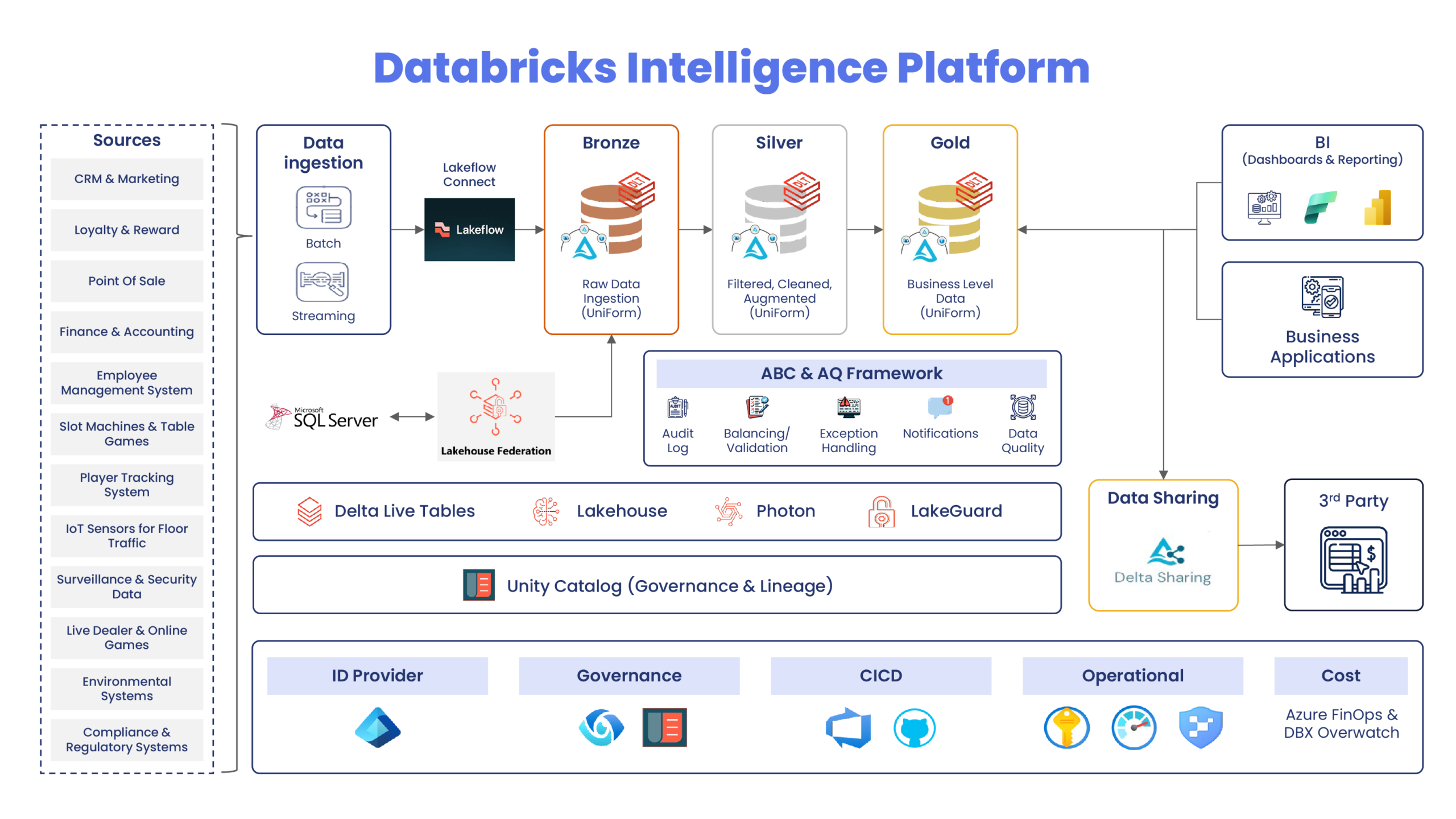
Wavicle Data Solutions assisted the enterprise in updating its data infrastructure by implementing a Databricks Lakehouse architecture utilizing Lakeflow Connect, Unity Catalog, and Azure DevOps. This initiative resulted in a robust, production-ready platform featuring hundreds of automated pipelines, comprehensive governance mechanisms, and advanced real-time analytics capabilities. The enterprise realized up to 50% improvement in data ingestion and processing times despite adding additional data sources.
Challenges
As business grew with higher data volumes, the enterprise struggled to scale the analytics platform across systems and teams.
- Fragmented enterprise data: Siloed systems limited unified insights across gaming, hospitality, finance, and digital operations.
- Manual ingestion processes: Data access varied across API interfaces, file-based ingestion, and databases ingestion. Manual orchestration was error-prone, making scaling slower and more complex.
- Limited governance and visibility: Lack of centralized governance and lineage reduced trust in enterprise data.
- Inconsistent deployment practices: Without standardized DevOps and CI/CD practices, maintaining consistency across environments was harder.
- Increasing regulatory and compliance requirements: As the enterprise grew, managing governance, security, and regulatory compliance became more complex.
- Need to support advanced analytics and AI initiatives: The enterprise also needed a scalable platform that could support future advanced analytics and AI use cases
Wavicle Data Solutions designed and implemented a modern Databricks Lakehouse platform tailored to the enterprise’s requirements.
Scalable Lakehouse foundation
Wavicle built a modern data foundation to unify fragmented data, automate ingestion pipelines and orchestration, and prepare analytics-ready data from across the enterprise. A Medallion architecture with structured bronze, silver, and curated data layers made it scalable to onboard additional properties and source systems over time.
Governance and visibility
To strengthen the trust in data, Wavicle implemented Unity Catalog and Microsoft Purview for improved governance, security, data lineage visibility, and metadata management across the platform.
Standardized delivery
Wavicle also standardized deployment and CI/CD practices to improve consistency across environments and support long-term operational scalability. This reduced complexity and created a more reliable foundation for future expansion.
Future-ready foundation
Together, these efforts established a scalable and governed data foundation that supports advanced analytics, innovation, and AI-driven decision-making.
Results
Wavicle’s solution transformed disconnected data into a scalable unified Databricks-based analytics foundation. With stronger data integration, improved visibility, and a foundation built for growth, the enterprise is better positioned to deliver faster insights and support future analytics and AI initiatives.
The implementation also delivered meaningful improvements across the enterprise’s data and analytics environment:
- Improved efficiency across enterprise data operations in Databricks
- Simplified, streamlined and automated platform management through standardized deployment and CI/CD practices
- Democratized access to faster insights through a centralized Lakehouse platform with all the source data captured in the bronze layer
- Stronger governance and security foundation through Unity Catalog implementation
- Scalable framework for onboarding future properties, systems, and analytics workloads
- Reusable architecture and data frameworks to support long-term growth. The data ingestion framework can be reused for new data sources reducing onboarding time and seamless data access
- A strong foundational platform for advanced analytics and future AI initiatives including 360-degree customer experience, identity resolution, and fraud detection
- Training and knowledge transfer enabled internal teams to support and expand the platform independently